

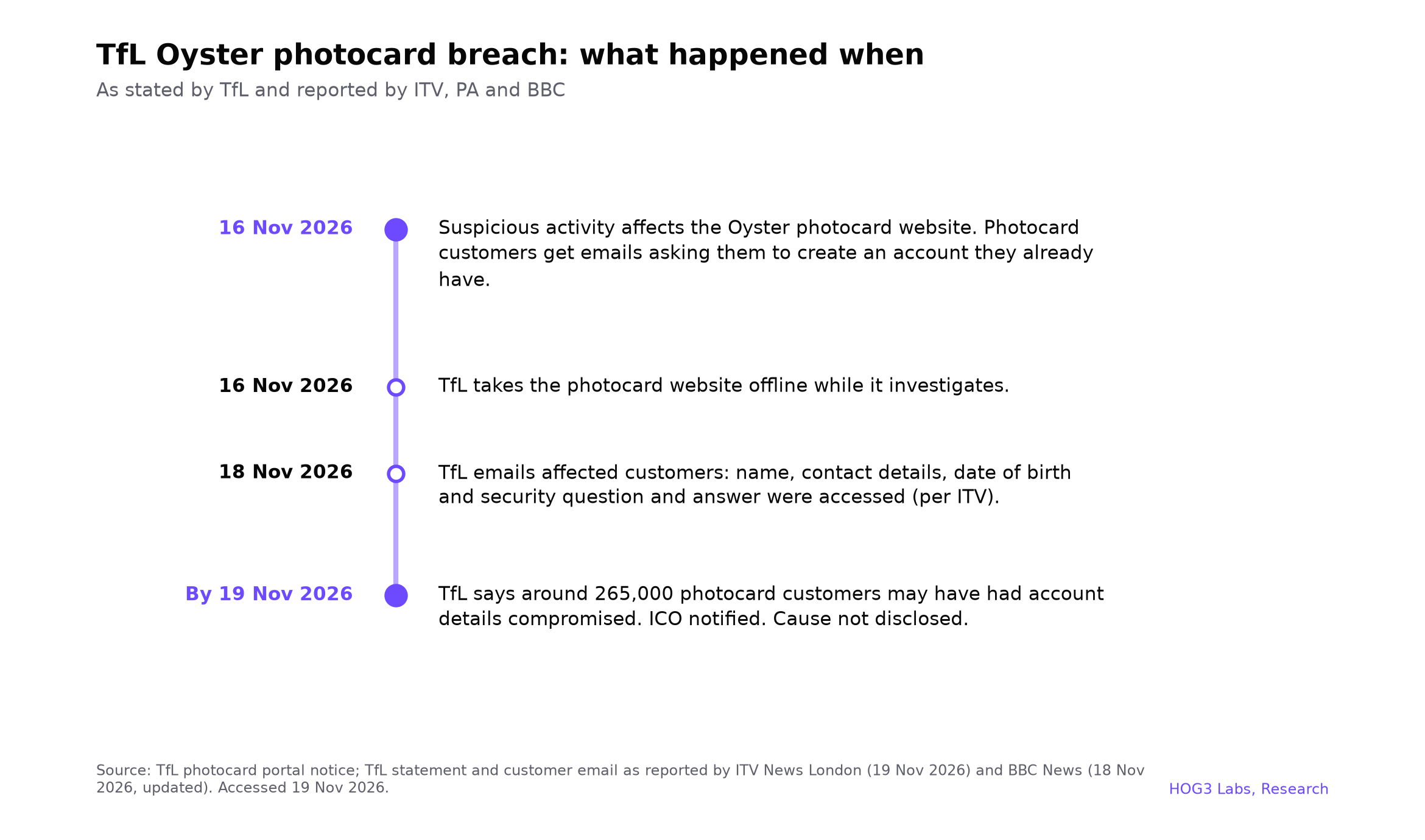
Transport for London (TfL) says about 265,000 Oyster photocard customers may have had their online account details compromised. The first visible sign came on Monday 16 November 2026: photocard holders started getting emails asking them to create an account they already had. TfL took the photocard website offline the same day. In emails to affected customers, it says names, contact details, dates of birth and security questions and answers were accessed. TfL has not said how the attacker got in, and we will not guess. What we can do is look at what was exposed, why that unusual email was such a useful early warning, and what both cardholders and teams running similar account portals should check.
TL;DR
- How many: about 265,000 photocard customers, per TfL.
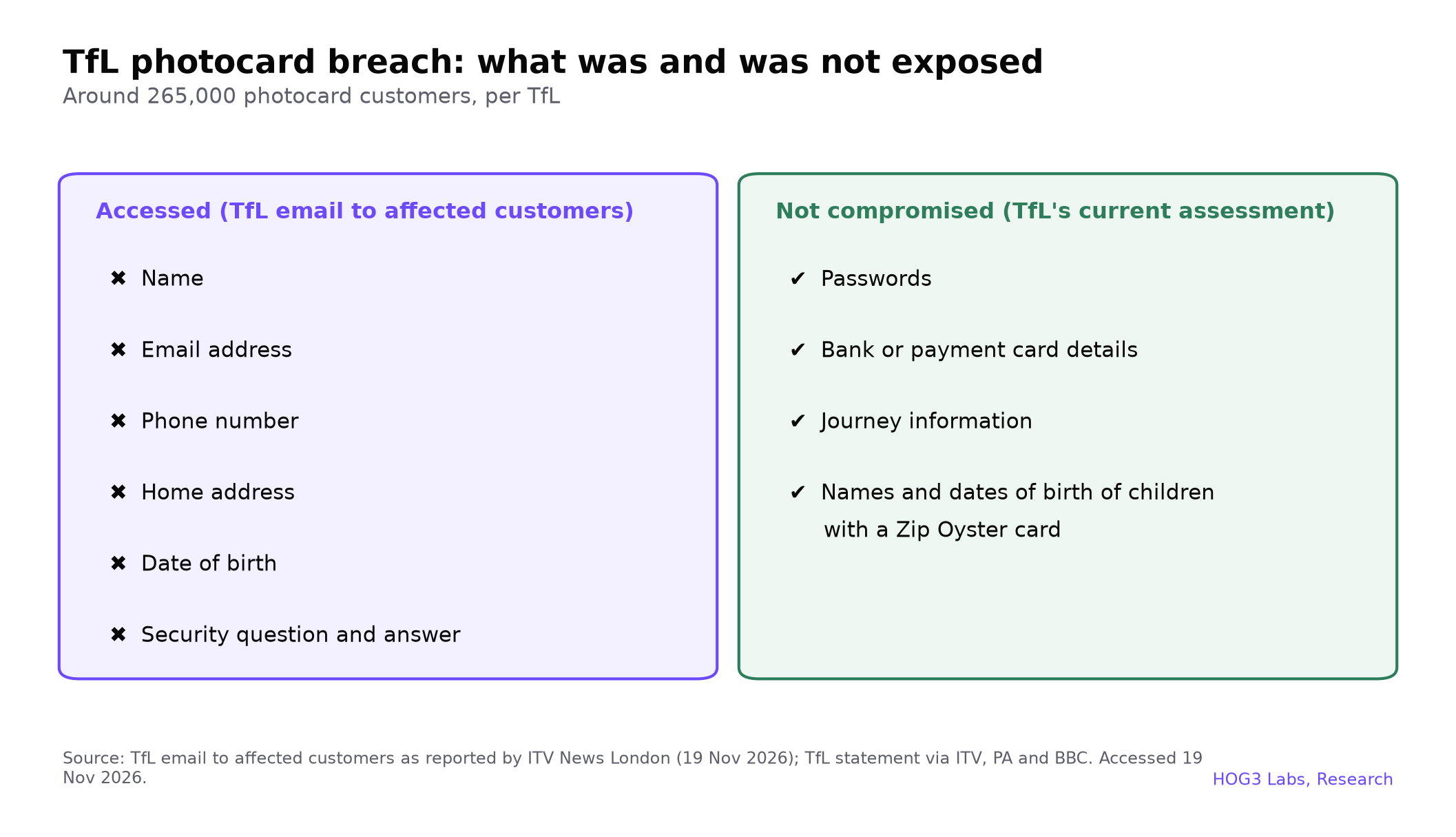
- What TfL told affected customers was accessed: name, email address, phone number, home address, date of birth, and security question and answer.
- What TfL says was not compromised, on its current assessment: passwords, bank or payment card details, journey information, and the names and dates of birth of children with a Zip Oyster card.
- How it surfaced: customers received unexpected "create an account" emails on 16 November 2026. TfL took the portal down while it investigated.
- Cause: not disclosed. TfL says it is still investigating and has notified the Information Commissioner's Office (ICO).
- Biggest practical risk: convincing phishing and phone scams that quote correct personal details, and any other service where the same security answer is still in use.
What TfL has said
| Item | Detail | Source |
|---|---|---|
| Date | Suspicious activity affecting the Oyster photocard website on 16 November 2026 | TfL email to customers, quoted by ITV and PA |
| Trigger | Photocard customers receiving emails asking them to create an account when they already had one | TfL photocard portal notice; Shashi Verma statement |
| Response | Photocard website taken offline; incident "contained" | TfL statement |
| Scale | "around 265,000 photocard customers may have had their account details compromised" | Shashi Verma, TfL director of technology strategy and revenue |
| Data accessed | Name, email, phone, home address, date of birth, security question and answer | TfL email to affected customers, per ITV |
| Not compromised (current assessment) | Passwords, bank or payment card details, journey information, names and dates of birth of children with a Zip Oyster card | TfL statement |
| Regulator | ICO notified | TfL |
| Card types affected | Zip Oyster (5-10, 11-15, 16+), 18+ Student, 18-25 Care Leaver, 60+ London, Apprentice, and Veterans Oyster photocards | TfL, per ITV and BBC |
Travel is not affected. TfL says photocards still work and can be topped up at ticket machines, but online photocard accounts are unavailable until the site is restored. Customers who need to renew or query journey history can contact TfL Customer Services.
Shashi Verma said: "Due to the speed with which this incident was identified and addressed, we believe that the number of customers who could have been affected was significantly reduced."
The BBC notes this is the second time in just over two years the photocard system has been taken down because of a cyber incident, after the September 2024 attack on TfL.
What is not known. TfL has not said how the access happened or who was behind it. It has said the unexpected emails came from its own system but were triggered by the compromise. Some outlets have called it a phishing scam. TfL has not used that description.
Why that "create an account" email mattered
Most breaches are found late, often by a third party. Here, customers noticed something odd within hours: a system email that did not match their situation.
That is a pattern worth stealing for any team that runs a customer portal. Your transactional emails, such as account creation, password reset, email change and "new device" notices, are a live record of what your account flows are doing. A sudden spike in one type, or emails going to people for whom that flow makes no sense, can be the earliest signal you get. TfL's own statement credits speed for limiting the number of affected customers.
We are not saying this is how the TfL incident worked. TfL has not said. The point is general: if your monitoring would not notice a burst of account-creation emails to existing customers, it is worth fixing.
What affected cardholders should do
- Expect targeted phishing. A message that quotes your correct name, address or date of birth is not proof it is from TfL. Go to TfL through its official site or app, not a link in a message.
- Change any reused security answer. Security questions and answers were exposed. If you used the same question and answer anywhere else, such as a bank, phone provider or email account, change it there. Where a service allows it, use a made-up answer stored in a password manager.
- Be wary of calls. Scammers may use your date of birth and address to sound official. Hang up and call back on a number you look up yourself.
- Passwords: TfL says passwords were not compromised, but as a precaution it is asking all photocard customers to change their password and security question and answer. If you reused your TfL password elsewhere, changing it on the other services is still good practice.
- Parents of Zip card holders: TfL says children's names and dates of birth on Zip Oyster cards were not compromised on its current assessment. Zip Oyster accounts are still on TfL's list of affected account types, so watch for scam messages to any email or phone number linked to them.
What teams running similar account portals should check
This list is general. It is not a claim about how TfL was breached.
1. Alert on odd transactional email patterns. Track volumes by type: sign-up, reset, email change, verification. Alert on spikes and on emails sent to existing customers through a "new customer" flow.
2. Test registration, lookup and recovery flows as an attacker would. These flows often answer questions like "does this account exist?" or "send me a link" without a full login. Check for account enumeration, missing rate limits, flows that reveal or change data before identity is proven, and access control on every API behind the portal, not just the pages.
3. Retire security questions as a login or recovery factor. Answers like a date of birth or first school are guessable and, after a breach, public. If you must keep them, treat them as weak and never as the only check.
4. Store less. If a portal does not need full address, phone and date of birth to do its job, do not keep them in the web account. What is not there cannot leak.
5. Plan the "take it offline" call. TfL could take the portal down quickly because the cards themselves kept working. Know in advance which customer services can be switched off without stopping the core service.
6. Retest before you reopen. When a portal comes back after an incident, confirm the path that was used is closed, and that the fix did not open a new one.
Where HOG3 fits
HOG3 continuously tests apps, APIs, cloud and identity within an authorized scope, with proof of impact, and retests after a fix. Customer account portals, with their registration, recovery and lookup flows, are a common place where authorization gaps show up. We had no involvement in this incident and do not know its cause. See how HOG3 works.
FAQ
How many people were affected by the TfL Oyster photocard breach? TfL says around 265,000 photocard customers may have had their account details compromised.
What data was exposed? According to TfL's email to affected customers, as reported by ITV: name, email address, phone number, home address, date of birth, and security question and answer. TfL says passwords, payment details and journey information were not compromised.
How did the breach happen? TfL has not said. It says it is still investigating and has notified the ICO.
Can I still use my Oyster photocard? Yes. TfL says photocards still work for travel and can be topped up at ticket machines. The online photocard account is unavailable for now.
Sources
All accessed 19 November 2026.
- TfL photocard portal notice
- ITV News London, 19 November 2026
- BBC News: Oyster photocard holders' personal data accessed in TfL breach
- The Independent
- HOG3 homepage
---