

On 17 November 2026, Oracle and the OpenJDK project released fixes for CVE-2026-114938, a memory corruption flaw in the Base64 decoder that Java uses on some x86-64 machines. The research firm Calif, which reported it, named it Java4Shell. Calif says it turned the flaw into remote code execution against default installs of Jira, Confluence, Jenkins, Keycloak, Artifactory and PingFederate. Other labs have reproduced crashes and a memory leak, and VulnCheck says it has a private working exploit, but no RCE exploit is public. CISA has asked everyone to patch immediately. The catch is that the flaw only runs on certain CPUs, so the real job is finding which of your Java runtimes are both affected and on those chips.
TL;DR
- What: a heap buffer overflow in the AVX-512 VBMI fast path of Java's Base64 decoder, reached through
java.util.Base64. VulnCheck describes it more precisely as an integer underflow that causes an out-of-bounds heap write. The runtime rejects the bad input, but only after the write has happened. - Affected: OpenJDK 17.0.6 through 17.0.21, 21.0.13 and earlier, 25.0.5 and earlier, and 27.0.1 and earlier, plus builds derived from them (Oracle Java SE, Corretto, Temurin, Zulu, Microsoft, Liberica, SapMachine, Red Hat). Oracle's Java 8 performance pack build 8u511b33-perf is also listed. Standard Java 8 and Java 11 are not.
- Only on certain hardware: x86-64 CPUs with AVX-512 VBMI. That means Intel Ice Lake and later server parts and AMD Zen 4 and later, and also some Intel client chips (Ice Lake, Tiger Lake, Rocket Lake) and Ryzen 7000 desktops, so developer laptops and build boxes can be in scope. ARM64 is not affected.
- Fixed in: the .1 builds. Oracle and OpenJDK 17.0.21.1, 21.0.13.1, 25.0.5.1 and 27.0.1.1. As of 22 November, Red Hat, Eclipse Temurin, Microsoft and BellSoft Liberica have all shipped fixed builds (table below).
- Severity depends on who scores it: 8.1 (CVSS 3.1, Oracle), 9.2 (CVSS 4.0, Calif), 9.8 (CVSS 3.0, Red Hat).
- Exploited? No confirmed exploitation in the public record. It is not in the CISA KEV catalog as of 22 November 2026. Sources differ on whether scanning has been seen.
- No patch yet? Restart the JVM with a flag that turns off the fast Base64 path. It is a stopgap, not a fix.
The facts, from the record
| Item | What the source says | Source |
|---|---|---|
| Disclosure and fix date | 17 November 2026. Oracle patch released 1:00 PM Pacific; Calif published the same day | Calif, OpenJDK, Oracle |
| Flaw | Hotspot compiler component, AVX-512 Base64 decode intrinsic; heap-based buffer overflow (CWE-122). Red Hat labels it CWE-787 | OpenJDK advisory, Canadian Cyber Centre, Red Hat |
| Reported by | Quang Luong of Calif (credited by Oracle). Original bug report credited to sundarms and albertnetymk | Calif |
| Oracle score | CVSS 3.1 8.1 (AV:N/AC:H/PR:N/UI:N), high attack complexity. NVD shows this score | Oracle Linux CVE page, OpenJDK advisory, NVD |
| Calif score | CVSS 4.0 9.2, Critical | Calif |
| Red Hat score | 9.8 (CVSS 3.0, AC:L), rated Critical | Red Hat |
| OpenJDK lines affected | 17, 21, 25, 27 (not 8, not 11) | OpenJDK advisory |
| Oracle builds affected | 8u511b33-perf, 17.0.21.0.3, 21.0.13.0.3, 25.0.5.0.3, 27.0.1.0.3; GraalVM for JDK 17.0.21.0.3 and 21.0.13.0.3; GraalVM EE 21.3.20.0.3 | Canadian Cyber Centre, Oracle Linux CVE page, Red Hat |
| Oracle fixed builds | 8u513-perf, 17.0.21.1, 21.0.13.1, 25.0.5.1, 27.0.1.1; GraalVM 17.0.21.1, 21.0.13.1, EE 21.3.20.1 | Canadian Cyber Centre, The Hacker News |
| CPU requirement | avx512f, avx512bw, avx512vbmi and bmi2 | CERT-EU, Red Hat |
| Stopgap flags | -XX:+UnlockDiagnosticVMOptions -XX:-UseBASE64Intrinsics or -XX:UseAVX=2 (x86-64 only) | CERT-EU, VulnCheck, Calif |
| CISA | Alert of 17 November 2026 urging immediate patching. Not in the KEV catalog as of 22 November 2026 | CISA alert, CISA KEV feed |
| Public proof of concept | Triggers the memory corruption only. Full exploit chains withheld by Calif. VulnCheck sells a full RCE exploit to its customers | SecurityWeek, BleepingComputer, VulnCheck |
| Oracle CSPU | The same update fixes 11 Java SE issues, all remotely exploitable without authentication | SecurityWeek, Tenable |
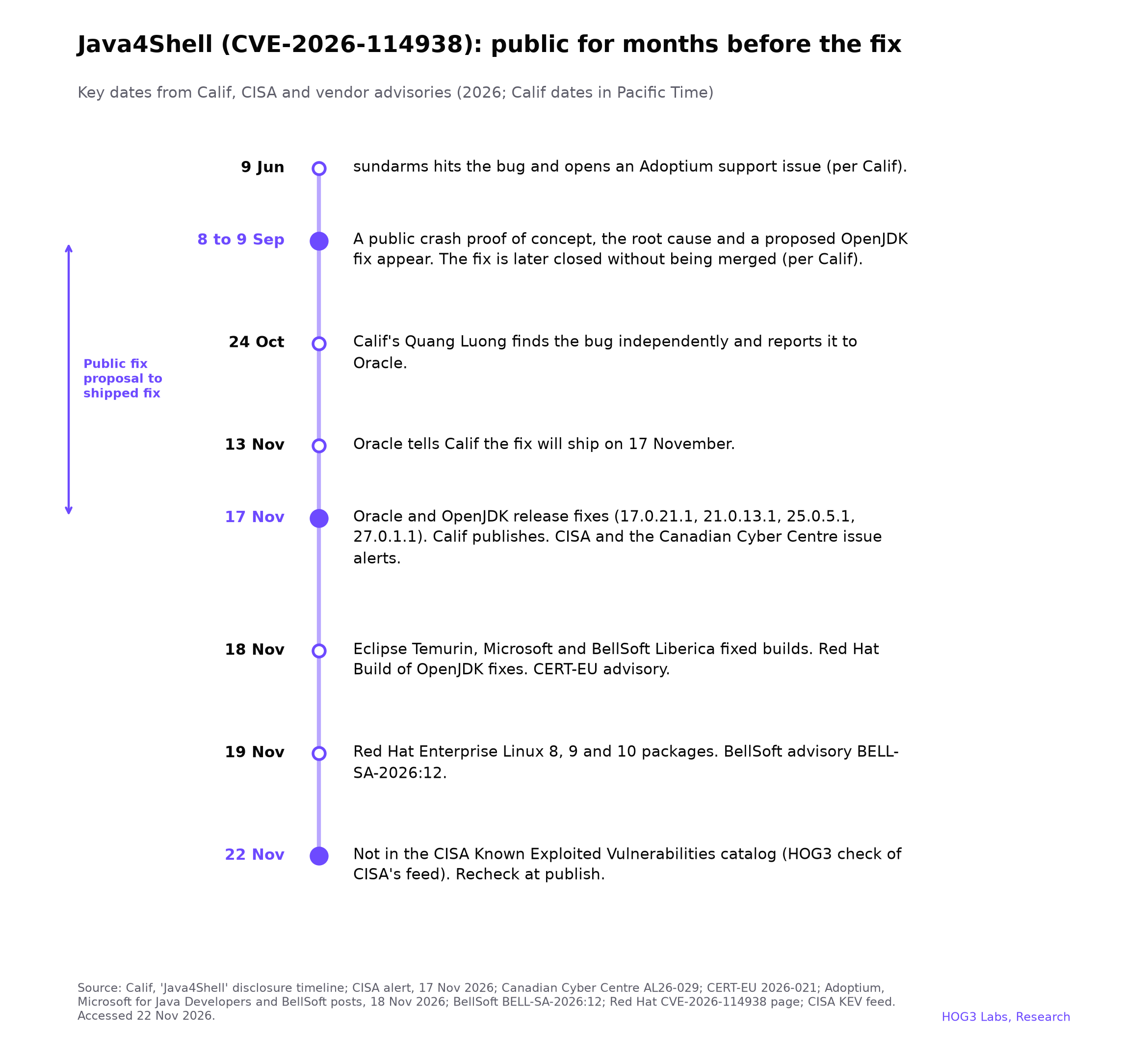
Timeline
Who is affected
You are exposed only if all three of these are true:
- 1. The runtime is affected. Java 17 from 17.0.6 through 17.0.21, Java 21.0.13 and earlier, 25.0.5 and earlier, and 27.0.1 and earlier, below the .1 fixed builds. That includes copies bundled inside products, appliances and container images.
- 2. The CPU takes the fast path. x86-64 with AVX-512 VBMI. The same container image can be exposed on one host and not on another.
- 3. Untrusted Base64 reaches the standard decoder. CERT-EU lists HTTP Basic authentication, JWTs, SAML messages, cookies and TLS data as typical routes.
Not affected per the sources: ARM64, x86-64 chips without VBMI (for example Skylake, Cascade Lake and Cooper Lake Xeons), and Java 8 and 11 apart from the Oracle performance pack build. Kudelski also reports the MIME decoder is not affected.
Do not assume it is only a server problem. VulnCheck notes that Intel's 2019 to 2021 client chips (Ice Lake, Tiger Lake, Rocket Lake) expose the feature, and that AMD Ryzen 7000 and 9000 desktops do too (Calif lists AMD Ryzen from Zen 4). Developer laptops, desktops and build boxes on those chips can be in scope. VulnCheck adds that Intel has fused AVX-512 off on its client processors since the 12th-generation Alder Lake parts.
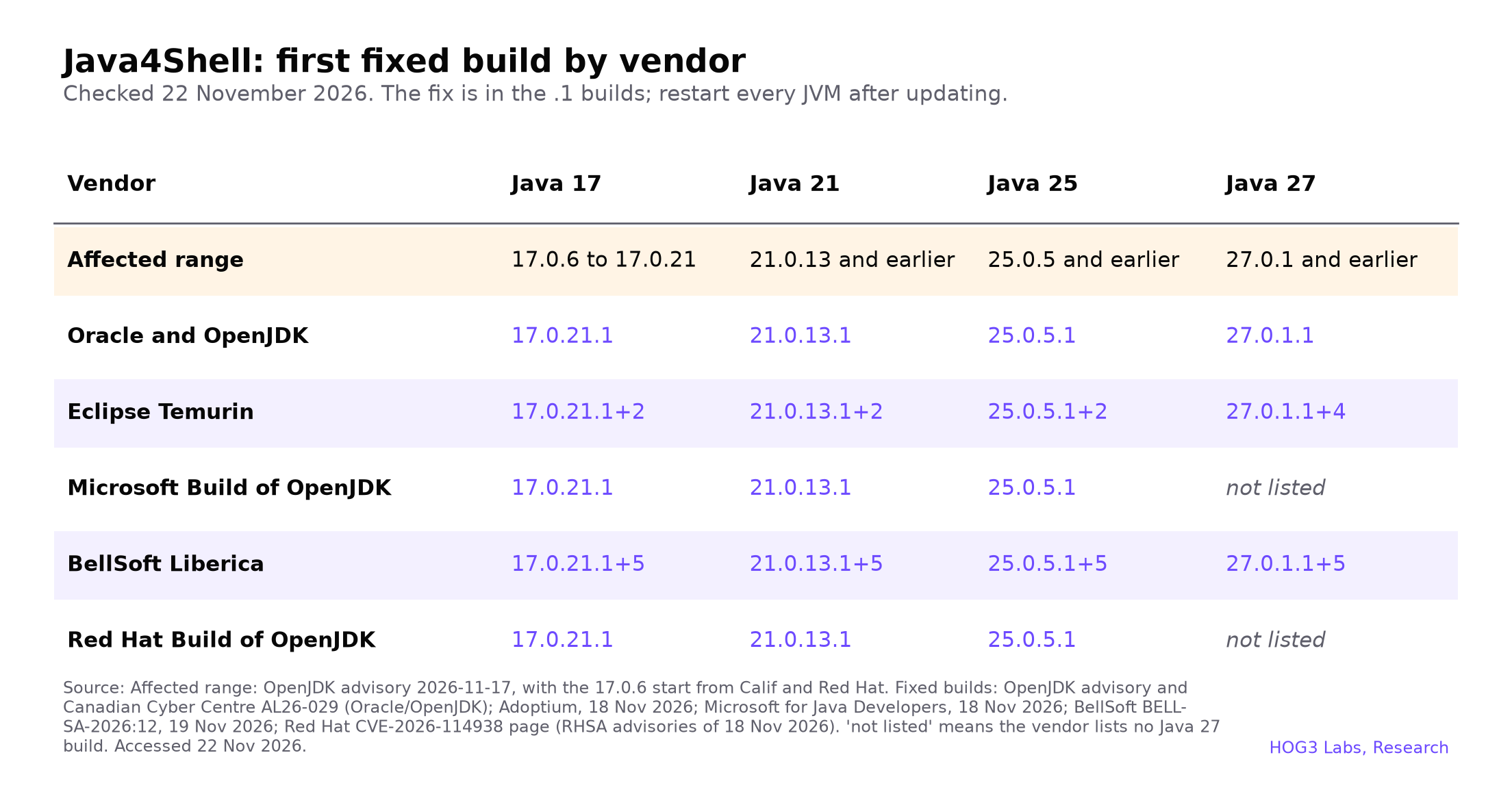
Fixed builds by vendor (checked 22 November 2026)
| Vendor | Java 17 | Java 21 | Java 25 | Java 27 | Source |
|---|---|---|---|---|---|
| Oracle and OpenJDK | 17.0.21.1 | 21.0.13.1 | 25.0.5.1 | 27.0.1.1 | OpenJDK advisory, Canadian Cyber Centre |
| Eclipse Temurin | 17.0.21.1+2 | 21.0.13.1+2 | 25.0.5.1+2 | 27.0.1.1+4 | Adoptium guidance, 18 Nov |
| Microsoft Build of OpenJDK | 17.0.21.1 | 21.0.13.1 | 25.0.5.1 | No Java 27 build listed | Microsoft for Java Developers, 18 Nov |
| BellSoft Liberica | 17.0.21.1+5 | 21.0.13.1+5 | 25.0.5.1+5 | 27.0.1.1+5 | BellSoft BELL-SA-2026:12, 19 Nov |
| Red Hat Build of OpenJDK | 17.0.21.1 | 21.0.13.1 | 25.0.5.1 | No Java 27 build listed | Red Hat CVE page (RHSA advisories of 18 Nov) |
All of them match the ranges above: the fix is in the .1 builds. Red Hat also shipped java-17, java-21 and java-25-openjdk packages for Red Hat Enterprise Linux 8, 9 and 10 on 19 November (for example java-17-openjdk-17.0.21.1.2 on RHEL 9). Its CVE page still lists several products that bundle Java as affected, including Red Hat Build of Keycloak, JBoss EAP container images, AMQ Broker, Streams for Apache Kafka and the OpenShift Jenkins images. The Hacker News (18 November) reported fixed Corretto and Zulu builds, and new SapMachine .1 builds whose release pages did not say what they fix. Check those vendors' own pages for exact numbers.
What the researchers say happened
Calif says a researcher found the bug with an AI coding assistant, working from the OpenJDK source. Calif's write-up also shows that the bug was partly public earlier. A report appeared in June 2026, and a crash proof of concept and a proposed fix appeared in OpenJDK's public repository in September. The proposed fix was later closed without being merged. Oracle confirmed a fix date to Calif on 13 November.
Calif says it achieved remote code execution without logging in against Keycloak, Jira, Confluence, Artifactory, Jenkins and PingFederate in default configurations. It also lists code execution after login against Kafka, Solr, Elasticsearch, Gerrit and Spinnaker, and a client-side case where a Java program connecting over TLS to a hostile server can be compromised. Calif says its lists are not exhaustive.
Others are more cautious. VulnCheck says crashing a vulnerable JVM is easy once an attacker finds a reachable input, but code execution needs heap grooming and a target-specific memory leak, so it does not expect the flaw to be widely or easily exploited. VulnCheck also says a full RCE exploit has been available to its paying customers since 17 November. Calif itself says there is no universal exploit. The Hacker News reports that Upwind and Blackpoint reproduced memory corruption, crashes and a local memory read, but not remote code execution.
We are not reproducing trigger details or exploit steps. The primary sources are linked below.
What this means in practice
It is a runtime bug, so the blast radius is the inventory problem. Java is rarely listed as its own asset. It sits inside Jira, Jenkins, Keycloak, appliances and base images. CISA's first action is to find those copies.
A crash is the realistic worst case for most teams today. Code execution has been shown by the reporter. Other labs have reproduced crashes and a memory leak, and VulnCheck says it has a private working exploit, but no RCE exploit is public. That is a reason to patch in order, not a reason to wait.
The hardware condition cuts both ways. It shrinks your exposure, and it also makes it hard to see from software inventory alone. Two identical containers can differ in risk.
Patching is not the end of it. The fix only counts once the running JVM restarts, and bundled runtimes wait for the product vendor.
What to do now
1. Find every Java runtime. Include JDKs bundled with third-party products, container images, CI agents and appliances. Record vendor and full build string, not just the major version. An SBOM or image scan helps, but check JREs bundled inside vendor products too.
2. Work out which ones are on AVX-512 VBMI. On Linux, check CPU flags for avx512f, avx512bw, avx512vbmi and bmi2. Treat anything with all four, running Java 17 or later, as in scope. Treat unknown as in scope. Include developer laptops and build machines, not only servers.
3. Patch to a fixed build, then restart. Oracle and OpenJDK: 17.0.21.1, 21.0.13.1, 25.0.5.1, 27.0.1.1. If you run another distribution, use its fixed build from the table above. Restart every JVM, and rebuild and redeploy container images so the running process uses the new runtime.
4. If you cannot patch yet, turn off the fast path. Start the JVM with:
-XX:+UnlockDiagnosticVMOptions -XX:-UseBASE64Intrinsics
This is the form CERT-EU and VulnCheck show. On Java 17 and later, UseBASE64Intrinsics is a product flag, so the unlock option is not strictly required, but it is harmless and lets the same line work everywhere. To confirm the setting took effect, run this with the same options your service uses and check that the value is false:
java -XX:+PrintFlagsFinal -version | grep UseBASE64Intrinsics
The other option is -XX:UseAVX=2. It turns off AVX-512 entirely and can cost performance. Use it on x86-64 only, because Java on ARM64 will not start with it. VulnCheck says it verified that the flags stop the overflow on OpenJDK 17, 21 and 25 only. Test on staging first, and remove the flag after patching.
5. Reduce exposure while you work. Prioritise internet-facing Java services and anything that accepts unauthenticated requests. CISA suggests limiting unauthenticated access and enforcing input-size limits. The Canadian Cyber Centre suggests isolating internet-facing applications from public networks if a fix cannot be applied. Input validation in the application is not a reliable fix on its own, because Kudelski reports the runtime rejects bad input only after the overflow.
6. Hunt for signs of probing. None of these prove a compromise, and none being present does not prove safety.
- Unexplained JVM crashes,
hs_err_pidcrash files, or restart bursts. - Bursts of
IllegalArgumentExceptionfromjava.util.Base64$Decoderin application logs. - Malformed tokens in Authorization headers or cookies in web and proxy logs.
- Unfamiliar Java processes or runtimes on hosts (a CISA indicator).
7. Rotate secrets on any exposed instance that crashed or looked probed. Calif's leak technique can expose heap contents, which it says may hold personal data, keys and tokens. If a vulnerable, internet-facing service showed suspicious crashes or malformed input, treat its in-memory secrets as possibly read: rotate API keys, signing keys and session secrets, and invalidate sessions.
8. Retest. Confirm the patched build is the one actually running, confirm the stopgap flag is gone or still intended, and check that no bundled runtime was missed.
Where HOG3 fits
HOG3 continuously tests apps, APIs, cloud and identity within an authorized scope, with proof of impact, and retests after a fix. For a runtime bug like this one, the useful question is which of your internet-facing services actually reach a vulnerable code path, and whether that is still true after patching. We will be plain about what we tested and what we did not. See how HOG3 works.
FAQ
What is Java4Shell? The name Calif gave to CVE-2026-114938, a memory corruption flaw in the AVX-512 Base64 decoder of OpenJDK 17 and later, fixed on 17 November 2026.
Which Java versions are affected? Java 17.0.6 through 17.0.21, 21.0.13 and earlier, 25.0.5 and earlier, and 27.0.1 and earlier, on x86-64 CPUs with AVX-512 VBMI. Oracle's Java 8 performance pack build 8u511b33-perf is also listed. Standard Java 8 and 11 and ARM64 are not.
Which versions fix it? The .1 builds: Oracle and OpenJDK 17.0.21.1, 21.0.13.1, 25.0.5.1 and 27.0.1.1. Temurin, Microsoft, Liberica and Red Hat have matching fixed builds, with their own build suffixes. See the table above.
Is there a workaround? Yes, a stopgap. Restart the JVM with -XX:+UnlockDiagnosticVMOptions -XX:-UseBASE64Intrinsics, or with -XX:UseAVX=2 on x86-64 hosts. Check it with java -XX:+PrintFlagsFinal -version | grep UseBASE64Intrinsics. Both need a restart, and neither replaces patching.
Can my laptop be affected? Possibly. VulnCheck says Intel Ice Lake, Tiger Lake and Rocket Lake client chips and AMD Ryzen 7000 and 9000 desktops have the feature. Most newer Intel laptops do not, because Intel turned AVX-512 off on client chips from Alder Lake onward.
Is Java4Shell being exploited in the wild? Not confirmed. CISA's alert does not say it is being exploited. The Canadian Cyber Centre, Cisco Talos and VulnCheck said they had not seen exploitation, while Dynatrace's 19 November post says scanning and exploitation attempts have been observed without confirmed success. Treat probing as likely.
Is it in the CISA KEV catalog? Not as of 22 November 2026. CISA's 17 November alert is a patch advisory, not a KEV listing. Check the catalog again before relying on this.
Why do the severity scores differ? Oracle scores it 8.1 on CVSS 3.1 with high attack complexity. Calif scores it 9.2 on CVSS 4.0. Red Hat's 9.8 assumes low complexity. Each reflects different assumptions about how reachable the decoder is.
Does input validation protect me? Not reliably. Per Kudelski's analysis, the runtime rejects bad input only after the overflow has already happened.
Sources
Accessed 20 November 2026. Rechecked 22 November 2026 where marked.
- Calif: Java4Shell, Write once, RCE everywhere (rechecked 22 Nov)
- OpenJDK Vulnerability Advisory, 2026/11/17 (rechecked 22 Nov)
- Oracle Linux: CVE-2026-114938 (quotes Oracle's CVE description and CVSS)
- NVD: CVE-2026-114938 (22 Nov)
- CISA: Critical Java Vulnerability Requires Immediate Patching, 17 November 2026 (rechecked 22 Nov)
- CISA: Known Exploited Vulnerabilities Catalog (checked 22 Nov)
- Canadian Centre for Cyber Security: AL26-029 (rechecked 22 Nov)
- CERT-EU: Security Advisory 2026-021 (rechecked 22 Nov)
- Red Hat: CVE-2026-114938 (rechecked 22 Nov)
- Eclipse Temurin guidance for CVE-2026-114938 "java4shell" (22 Nov)
- Microsoft for Java Developers: Java OpenJDK November 2026 Critical Patch Update (22 Nov)
- BellSoft: BELL-SA-2026:12, Liberica JDK vulnerabilities fixed (22 Nov)
- BellSoft: Addressing Java4Shell in Liberica JDK (22 Nov)
- VulnCheck: Java4Shell CVE-2026-114938 (rechecked 22 Nov)
- BleepingComputer: Critical Java4Shell flaw allows RCE attacks on major Java applications
- SecurityWeek: Java4Shell vulnerability puts enterprise applications at risk of takeover (rechecked 22 Nov)
- The Hacker News: Java4Shell flaw enables pre-auth RCE in Jira, Jenkins, Keycloak and more (rechecked 22 Nov)
- Dynatrace: Java4Shell, which Java runtimes are affected and how to fix them (rechecked 22 Nov)
- Tenable: Oracle November 2026 CSPU
- Daily CISO: CISA urges Java4Shell patch, 20 November 2026 briefing
- HOG3 homepage