

On 13 November 2026, an attacker broke into KARTE, a customer experience and marketing platform run by Tokyo-listed PLAID. Within days, company after company in Japan published its own notice. MUFG Bank says about 6.5 million of its customer records leaked. Golf Digest Online says up to 6,974,506 member records. By 19 November, an independent tracker had confirmed official notices from 20 client companies. The bank's own systems were never touched. That is the point. The most important line in PLAID's disclosure is not a record count. It is that the attacker also took the secret keys and access tokens customers use to connect KARTE to other services, and PLAID is asking every client that set up integrations to revoke them.
TL;DR
- Vendor: PLAID, Inc. (TSE Growth: 4165), maker of the KARTE platform.
- What PLAID says happened: an attacker exploited a server vulnerability, stole system and database credentials, read data out, then used stolen credentials to take over a PLAID account and access the admin console.
- What PLAID confirmed leaked: 79,249 KARTE account email addresses; integration secrets such as secret keys and access tokens (count under investigation); and part of the customer data clients imported into KARTE (count under investigation).
- MUFG Bank: about 6.5 million records of gender, age and area of residence. No names, addresses, phone numbers or emails, and no access to the bank's own systems. Sankei reports about 8 million records across five MUFG group companies.
- Scale: at least 20 client companies have published notices, per ITDef's tracker. Each counts differently, so the numbers cannot be added up.
- If you use KARTE, or any vendor that holds keys into your stack: revoke those integration keys now, and check what they could reach.
What PLAID disclosed
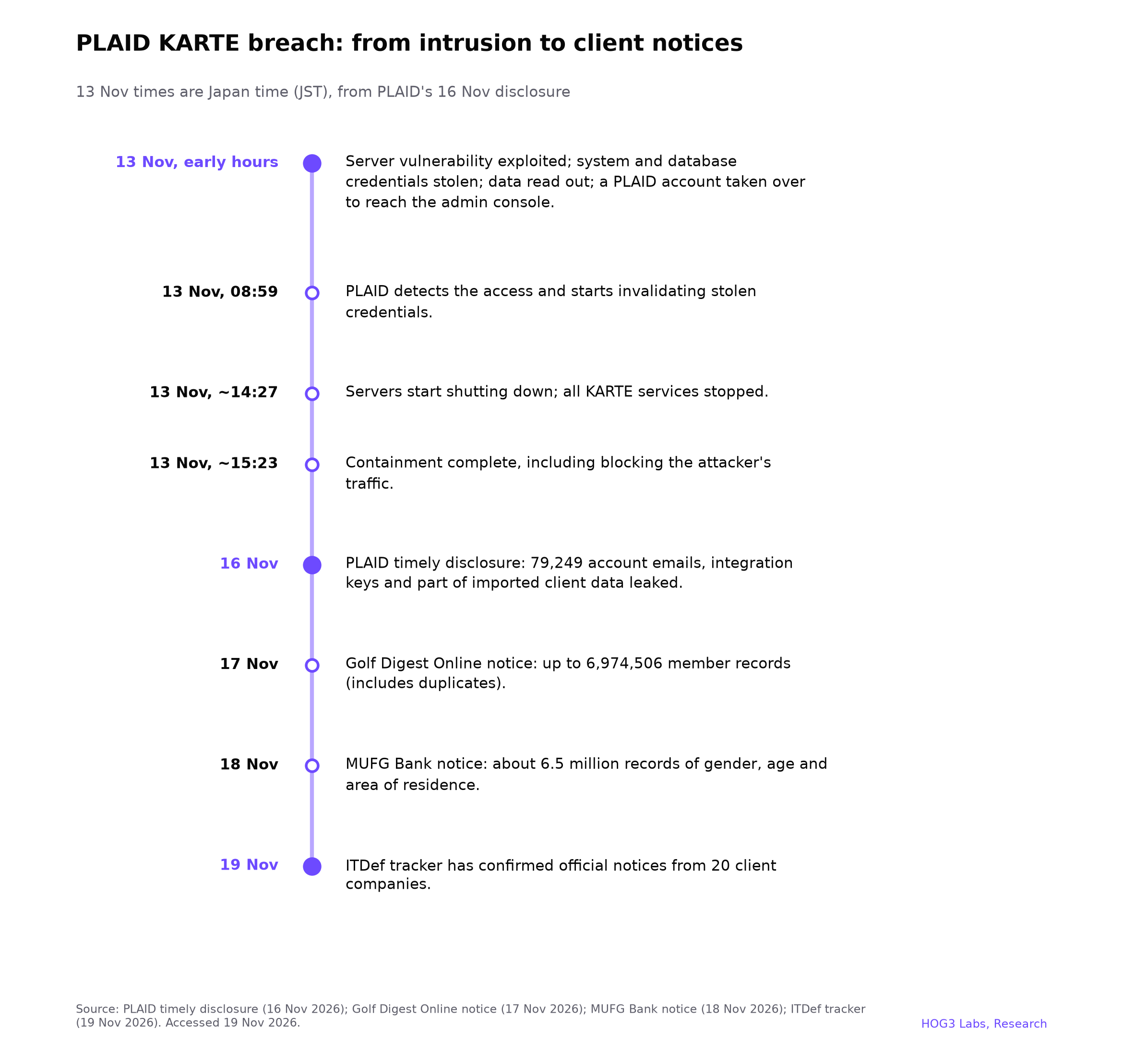
PLAID published a timely disclosure on 16 November 2026. Its timeline, in Japan time:
| Time (JST, 13 Nov 2026) | Event |
|---|---|
| Early hours | Third party exploits a server vulnerability, steals system and database connection credentials, and reads data out. Stolen credentials are used to take over a PLAID account and reach the admin console. |
| 08:59 | PLAID detects the unauthorized access and starts invalidating stolen credentials. |
| From about 14:27 | Servers start shutting down; all KARTE services moved to maintenance mode and stopped. |
| By about 15:23 | Containment complete, including blocking the attacker's traffic. |
PLAID says it has seen no new unauthorized access since then. It has reported to Japan's Personal Information Protection Commission, is consulting the police, and plans an external forensic investigation. KARTE has no restart date. PLAID has not published the specific vulnerability.
What PLAID has confirmed leaked so far:
| Data | Count |
|---|---|
| Email addresses registered as KARTE accounts | 79,249 |
| Credentials used to link KARTE to external services (secret keys, access tokens and similar) | Under investigation |
| Part of the customer data client companies imported into KARTE, which may include personal information | Under investigation |
The numbers, attributed
Every company counts in its own way: records, people, or email addresses, sometimes with duplicates. Do not add these together.
| Company | Count | What it says leaked | Source |
|---|---|---|---|
| MUFG Bank | About 6.5 million records | Gender, age, area of residence (prefecture or designated city). No information that identifies or contacts customers. Bank systems not accessed. No misuse confirmed | MUFG Bank notice, 18 Nov |
| MUFG group (five companies incl. the bank) | About 8 million records in total | Names and addresses not included | Sankei, 18 Nov |
| Golf Digest Online | Up to 6,974,506 member records (includes duplicates) | IDs, birthday or birth month, age band, postal code, mail preferences | GDO notice, 17 Nov |
| 20 client companies in total | Varies by company | Ranges from age and region only to names, birthdates, emails and phone numbers at some companies | ITDef tracker, 19 Nov |
None of the notices ITDef checked lists passwords or card details as leaked.
Why the integration keys are the real story
Record counts get the headlines. The keys are what should worry security teams.
KARTE, like many marketing and analytics tools, connects to other systems so it can send messages, sync audiences or pull customer data. To do that, client companies give it secret keys and access tokens. PLAID now says those integration credentials were taken, and it warns clients that if they do not invalidate them, the connected services could suffer "unintended data writes or leaks."
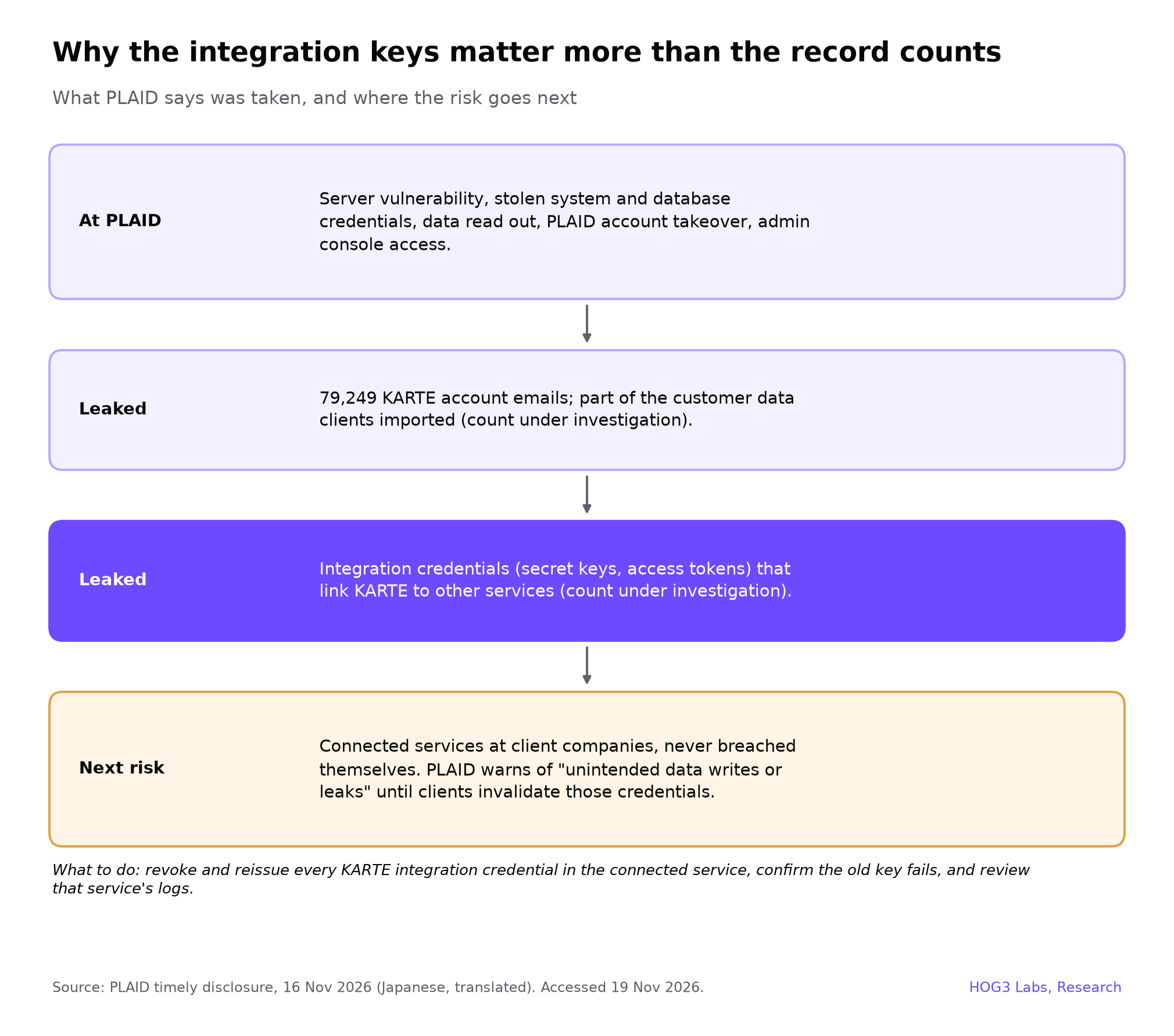
Put plainly: the attacker may hold working keys into systems that were never breached, at companies that did nothing wrong except use a popular vendor. Until each client revokes every key, the incident is not really contained for that client, no matter what PLAID's own servers look like.
There is a second, quieter lesson in MUFG's notice. MUFG Bank's 6.5 million leaked records held only gender, age and region, with no names or contact details. Other clients' notices list more.
What to check now
If you use KARTE:
- 1. Revoke and reissue every integration credential you set up in KARTE, as PLAID requests. Do it in the connected service, then confirm the old key fails.
- 2. Review logs in each connected service from 12 November 2026 UTC (the early hours of 13 November in Japan) until you revoked them, especially writes, exports, bulk reads or new users.
- 3. List what you imported into KARTE, for example through its data-linking table feature, so you know what personal data was in scope.
- 4. Warn your customers about phishing that uses your brand. PLAID also warns that its account holders may get fake emails pretending to be from PLAID.
If you use any third-party tool that holds keys into your stack:
- 1. Inventory vendor-held credentials. Which vendors hold API keys, OAuth tokens or service accounts into your systems, and who owns each one?
- 2. Scope them down. A marketing tool usually needs to send messages or read a segment, not write to your CRM or read your whole customer table.
- 3. Make revocation a one-hour job. Decide in advance who can kill a vendor integration, and how you will reissue keys when the vendor comes back.
- 4. Send less. MUFG's notice is a good model. If the vendor does not need names or contact details, do not send them.
- 5. Test what a vendor key can actually reach. Assume one leaks someday. Know in advance what it opens.
Where HOG3 fits
HOG3 continuously tests apps, APIs, cloud and identity within an authorized scope, with proof of impact, and retests after a fix. That includes asking what a leaked integration key or vendor connection could reach in your environment, and confirming after rotation that the old path is closed. We had no involvement in this incident. See how HOG3 works.
FAQ
What is the PLAID KARTE breach? On 13 November 2026, an attacker exploited a vulnerability in a PLAID server, stole credentials and data, and reached the KARTE admin console. PLAID stopped all KARTE services the same day.
How many MUFG Bank customers were affected? MUFG Bank says about 6.5 million records leaked, covering gender, age and area of residence only. Sankei reports about 8 million records across five MUFG group companies.
How many companies were affected? PLAID has not published a list. ITDef had confirmed official notices from 20 client companies as of 19 November 2026.
Were passwords or card details leaked? None of the company notices ITDef reviewed lists passwords or card details as leaked.
What should KARTE customers do first? Invalidate every credential used to link KARTE to external services, as PLAID requests, and review activity in those connected services.
Sources
All accessed 19 November 2026.
- PLAID timely disclosure, 16 November 2026 (Japanese, PDF)
- PLAID news, 16 November 2026 (Japanese)
- MUFG Bank notice, 18 November 2026 (Japanese, PDF)
- Golf Digest Online notice, 17 November 2026 (Japanese)
- Sankei, 18 November 2026 (Japanese)
- ITDef: Customer Analytics Breach 2026
- HOG3 homepage
---