

On 16 November 2026, Google Threat Intelligence Group (GTIG) and Mandiant said that for the first time they had seen attackers fully automate finding and exploiting vulnerabilities, with no human in the loop. The framework they found reads fresh patches, writes the exploit and runs it. The practical meaning is that the gap between "patch released" and "patch exploited" is shrinking. Patching, and proving the patch worked, now has to happen in days.
What happened
GTIG's quarterly AI Threat Tracker says it found an exposed staging server hosting a multi-agent framework the operators called exploit_agent. It connects to several frontier and local models and runs continuous differential analysis of popular web application software. It compares code before and after patch announcements, looks for the vulnerability, drafts an exploit and executes it automatically. Victim telemetry on the server suggests the operator targeted French websites in media, entertainment and education.
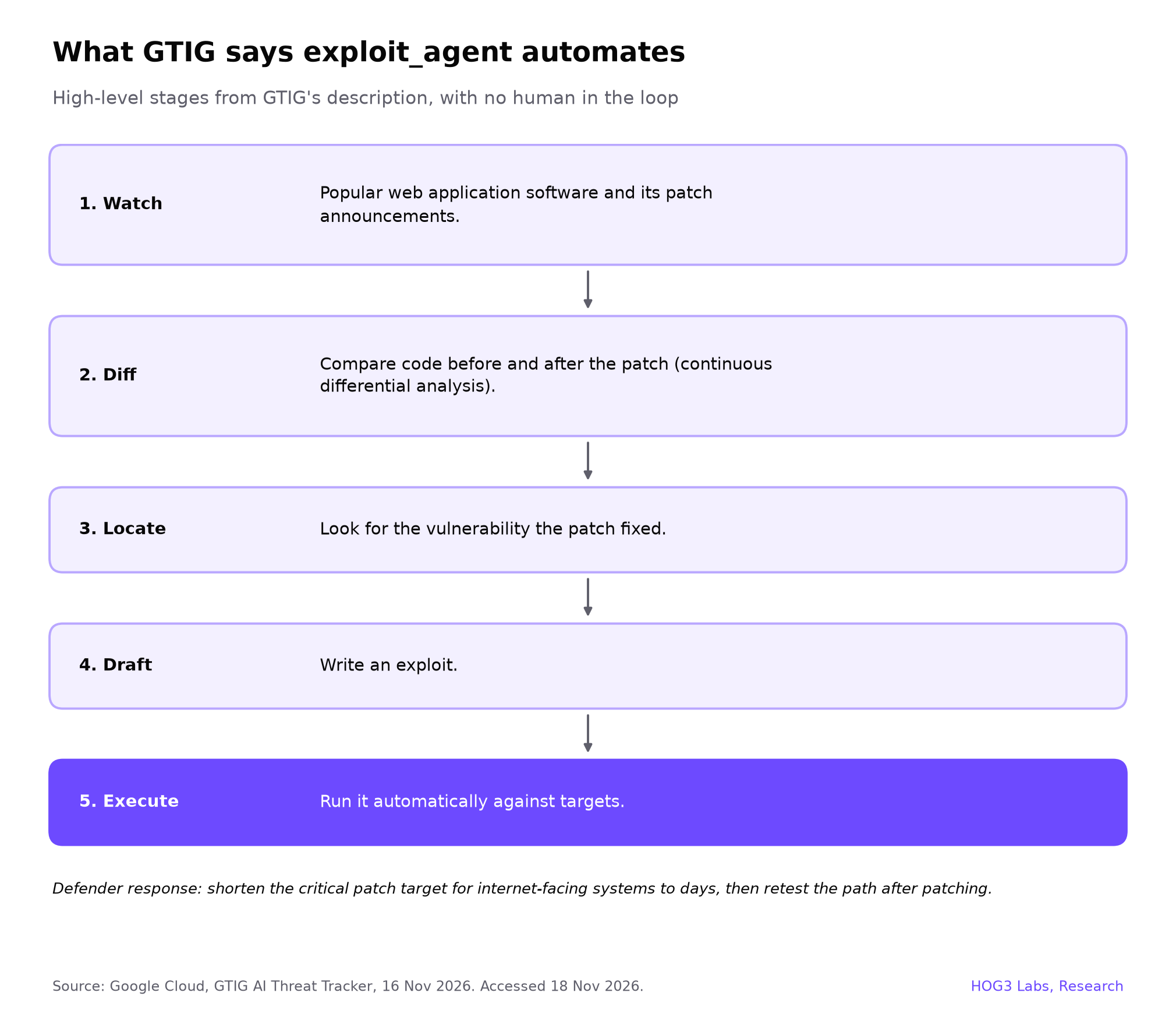
GTIG's words: "In the past quarter, GTIG identified threat actors using LLM frameworks to fully automate vulnerability discovery and exploitation without a human in the loop for the first time."
The same report says attackers are using ARTEX and open-source agentic pentest frameworks such as CAIRN and PentAGI in live intrusions, and testing others like CyberStrikeAI. GTIG says these frameworks share a few core abilities: finding and exploiting low-complexity vulnerabilities, generating single-use payloads on demand, and adjusting tactics from real-time feedback. Its summary is blunt. The mechanics have not changed, since attackers still use compromised credentials and unpatched systems. The speed and scale have.
The numbers behind the patch window
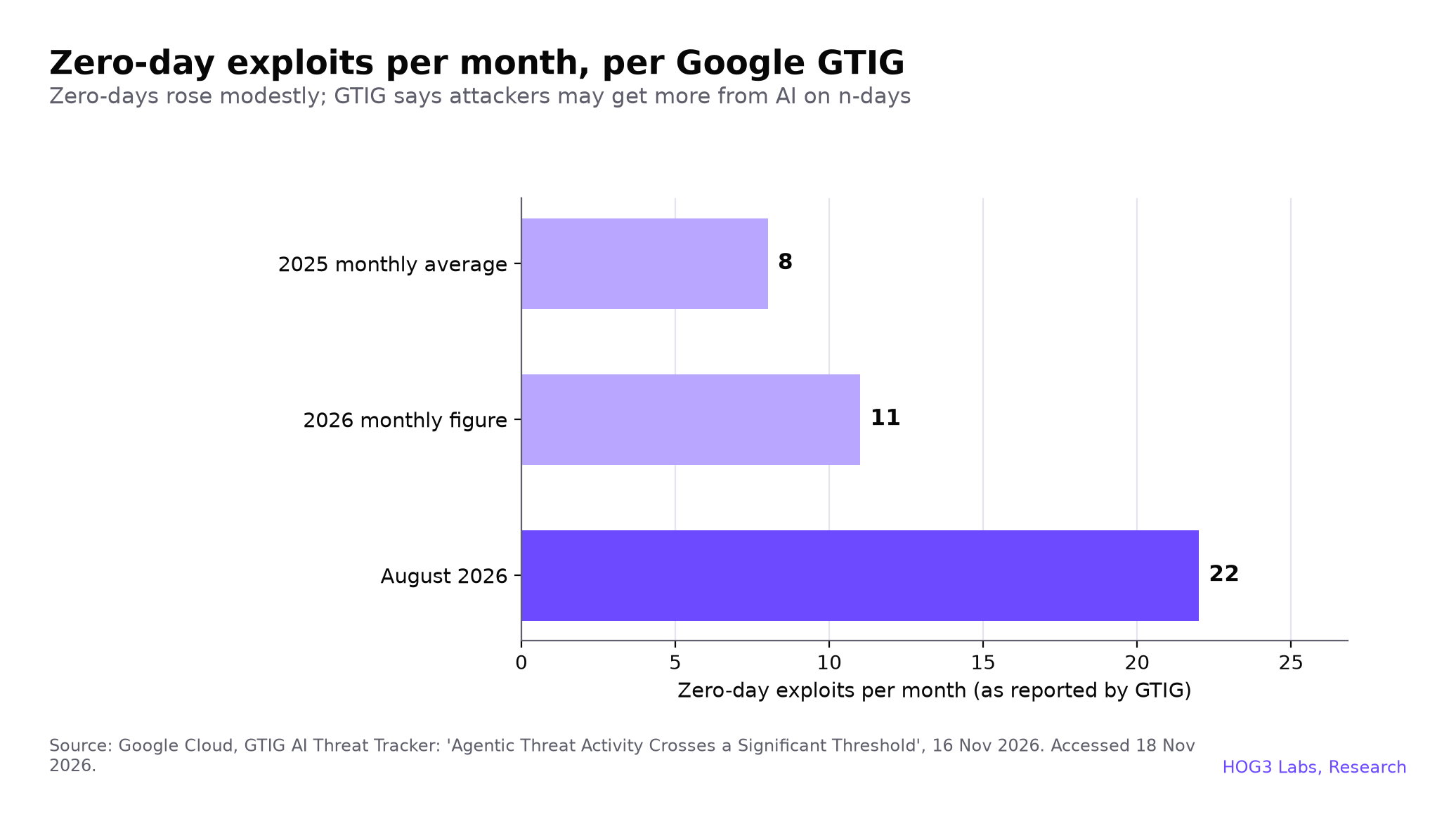
GTIG says overall vulnerability disclosures and exploits nearly doubled between January and August 2026. Zero-day exploits rose only from a 2025 average of 8 a month to 11 a month in 2026, before spiking to 22 in August. GTIG suggests attackers may find it more efficient to use AI on known, patched flaws (n-days) than to hunt for new ones.
Two examples in the report show the pace. After two chained PaperCut flaws were exploited as zero-days in late August, researchers and Huntress used AI to build working exploits within a day of disclosure. GreyNoise reported a widespread campaign four days after disclosure in which the attacker likely used AI to build and test exploits. The PHP flaws patched on 21 October were found using AI-assisted analysis. A proof-of-concept video and early patched code appeared before the official fix. In the days after the patch, hundreds of claimed but non-working exploits were published, which created extra verification work for defenders.
Why it matters for security buyers
Most patch policies were written for a world where weaponizing a patch took skilled people weeks. GTIG is describing a pipeline that reads the patch itself. If your target for internet-facing critical fixes is 30 days, that window now favors the attacker.
The fake exploit flood matters too. A public exploit that fails against your system does not prove you are safe. It may simply be a bad exploit.
There is one piece of good news. GTIG says these frameworks currently trade stealth for speed. They generate noisy forensic traffic and leave recognizable traces, so they can be detected if someone is looking.
What to test this week
- 1. List what faces the internet, including plugins and add-ons on CMS platforms. GTIG's report shows an agentic framework inspecting access control in a WordPress plugin.
- 2. Match it against the last 30 days of vendor advisories, and confirm the fixed version is what is actually running.
- 3. Shorten the critical patch target for internet-facing systems from weeks to days.
- 4. Retest the path after patching. Do not rely on a public proof of concept as your test.
- 5. Protect cloud and AI keys. GTIG reports LLMJacking cases where fraudulent single-day charges exceeded $100,000.
- 6. Make sure noisy, high-volume automated probing raises an alert in your monitoring.
Where HOG3 fits
HOG3 runs continuous, autonomous AI pentesting on your apps, APIs, cloud and identity, inside a scope you authorize. When it finds a path, it shows the evidence. After your engineers fix it, HOG3 repeats the attack to confirm the path is closed. That is the loop GTIG's findings put under time pressure. We did not observe the activity in this report. See how HOG3 works.
Sources
All accessed 18 November 2026.