

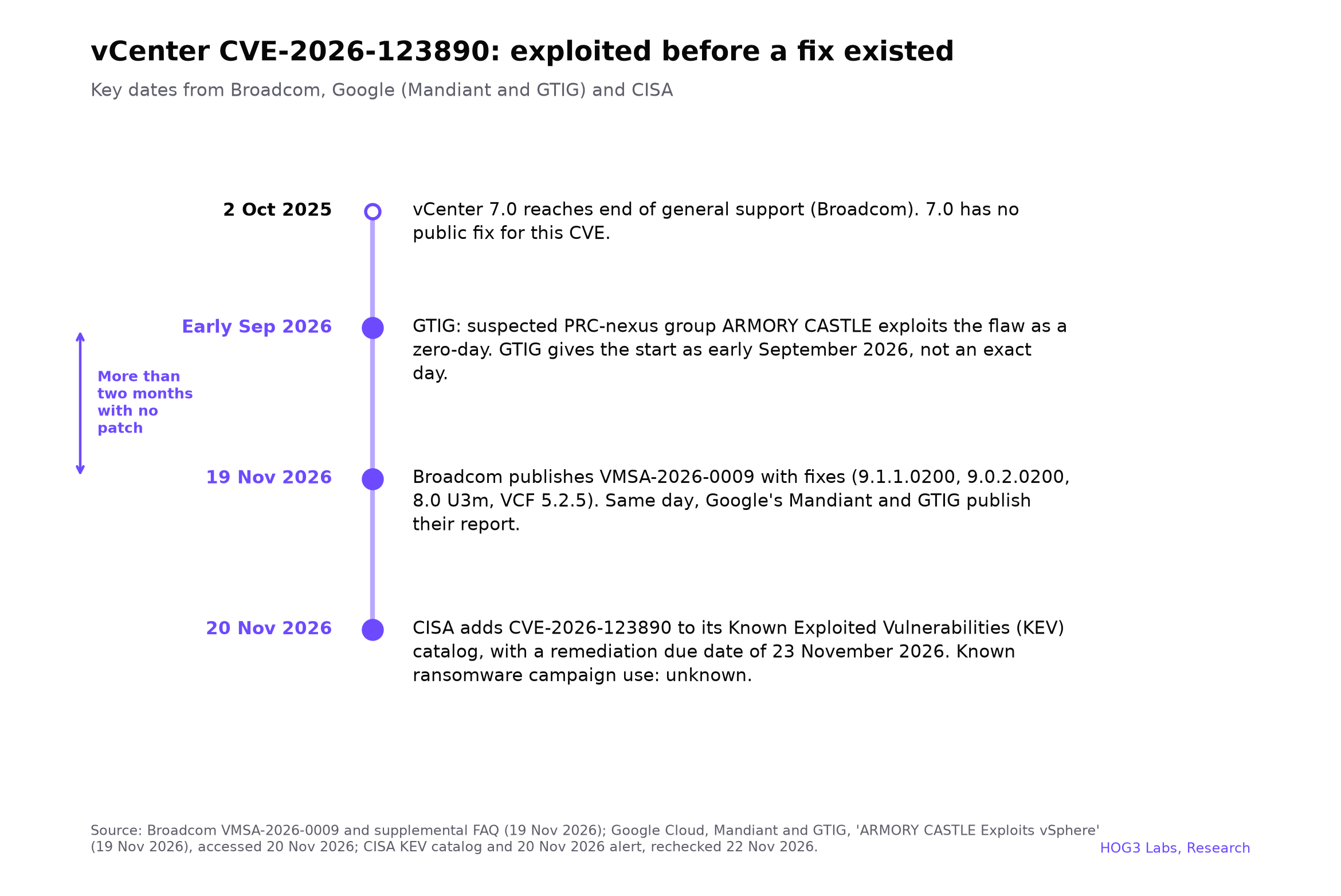
On 19 November 2026, Broadcom released fixes for CVE-2026-123890, a critical authentication bypass in the VMware Directory Service of vCenter Server. It scores 9.8 under CVSS 3.1 and has no workaround. The same day, Google's Mandiant and Threat Intelligence Group (GTIG) reported that a suspected China-linked group they call ARMORY CASTLE used it as a zero-day in early September 2026, more than two months before the patch existed. vCenter is the control plane for a virtualized data center, so whoever holds an administrator session there can reach the hosts and virtual machines underneath. If you run vCenter, patching is step one. Checking whether you were reached before the patch is step two.
TL;DR
- What: an unauthenticated authentication bypass in vCenter's Directory Service (
vmdird). Per Broadcom, an attacker with network access to vCenter can gain unauthorized access. Per GTIG, a successful attack yields an authenticated session asadministrator@vsphere.local. - Severity: CVSS 3.1 base score 9.8, Critical. Workarounds: none.
- Fixed in: vCenter 9.1.1.0200, 9.0.2.0200, 8.0 U3m, and VMware Cloud Foundation 5.x via 5.2.5.
- vCenter 7.0: no public fix, and past end of general support (2 October 2025). Treat it as vulnerable and cut its network exposure now.
- Exploited? GTIG says yes, from early September 2026. Broadcom's advisory does not say so. CISA added it to its Known Exploited Vulnerabilities (KEV) catalog on 20 November 2026, with a remediation due date of 23 November 2026, and marks known ransomware campaign use as unknown.
- After patching: limit who can reach vCenter, rotate the SSO signing certificate and passwords, and look for signs of earlier access. A patch does not remove an attacker who is already in, and it does not stop forged SAML tokens.
Timeline at a glance
The facts, from the record
| Item | What the source says | Source |
|---|---|---|
| Advisory | VMSA-2026-0009, published 19 November 2026, severity Critical | Broadcom |
| Flaw | Authentication bypass in the VMware Directory Service | Broadcom |
| Score | CVSS 3.1 9.8 (vector AV:N/AC:L/PR:N/UI:N) | Broadcom, Rapid7 DB |
| Workarounds | None | Broadcom |
| Reported by | Mandiant | Broadcom |
| Fixed versions | 9.1.1.0200, 9.0.2.0200, 8.0 U3m, VCF 5.x 5.2.5; Telco Cloud products see KB 463116 (vCenter 8.0 U3m) | Broadcom |
| vCenter 7.0 | "Contact Broadcom Support if you have extended support contract" | Broadcom |
| Mechanism (GTIG) | Unauthenticated SRP-6a session key disclosure over DCE/RPC, which creates an authenticated session as administrator@vsphere.local | Google Cloud blog |
| Exploitation | Early September 2026, by ARMORY CASTLE (formerly UNC5221), suspected PRC-nexus | Google Cloud blog |
| CISA KEV | Added 20 November 2026; remediation due date 23 November 2026; known ransomware campaign use: unknown | CISA KEV catalog |
| Other CVEs in the advisory | CVE-2026-123891 to CVE-2026-123894, in SDDC Manager and VMware Tools for Windows | Broadcom |
Who is affected
Broadcom's guidance is blunt: you are affected if you run any vCenter version below the fixed versions in the advisory. That includes vCenter deployed on its own and as part of VMware Cloud Foundation, vSphere Foundation, Telco Cloud Platform and Telco Cloud Infrastructure. Broadcom's supplemental FAQ confirms it applies whether or not Enhanced Linked Mode is on.
Patches are cumulative, so a newer build than the ones listed also covers it. There is no workaround, and the fix can't be applied with quick patch. VCF 5.x customers patch through the asynchronous process in Broadcom KB 88287.
| You run | Move to | Notes |
|---|---|---|
| vCenter 9.1.x | 9.1.1.0200 | Patches are cumulative; a newer build also covers it |
| vCenter 9.0.x | 9.0.2.0200 | Same |
| vCenter 8.0 | 8.0 U3m | Telco Cloud products: see KB 463116 |
| VMware Cloud Foundation 5.x | 5.2.5 | Asynchronous patching per KB 88287 |
| vCenter 7.0 | No public fix | Past end of general support (2 October 2025). Cut exposure; ask Broadcom if you have extended support, otherwise plan the move to 8.0 U3m |
Source: Broadcom VMSA-2026-0009, supplemental FAQ and KB 463116.
What GTIG says happened
GTIG describes an intrusion that did not start at vCenter. ARMORY CASTLE first compromised a BeyondTrust Remote Support appliance, which GTIG had covered in an earlier post as CVE-2026-102764. From there it reached an internal Linux appliance, escalated to root, and scanned for VMware systems.
The group then used a custom Go tool, BONESAW, against vCenter. GTIG says BONESAW created a Single Sign-On administrator account and pulled the directory database (data.mdb). GTIG says it can also extract the SAML signing key used by vCenter's token service. A second tool, SAWSNAKE, enables "Golden SAML" attacks: forged authentication tokens that bypass multifactor authentication and impersonate any user. GTIG does not say the signing key was taken in this specific intrusion.
According to GTIG, the actor also enabled SSH on the vCenter appliance through its management interface, then moved on to ESXi hosts and extracted data from virtual machines, including Active Directory database files. GTIG's own summary is that two zero-days and three sets of tailored malware in one campaign point to significant resources behind it.
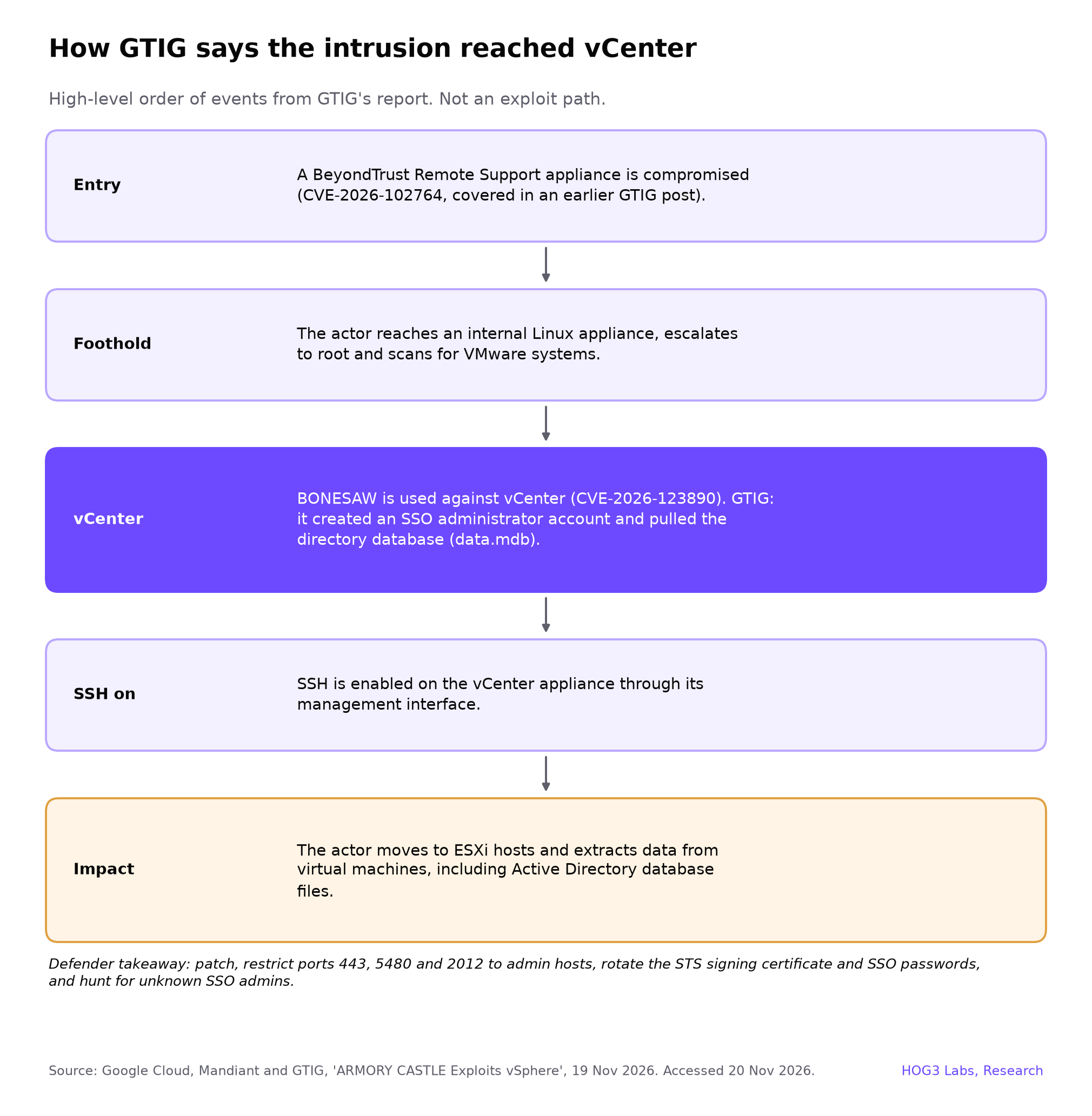
We are not reproducing exploit details. GTIG's report includes indicators of compromise and detection rules for defenders, and we link it below.
What this means in practice
Three things stand out.
The patch gap is long. Exploitation began in early September. The fix arrived 19 November. Any environment that was reachable and attacked in that window may hold a stolen directory database and signing key even after it is patched.
vCenter holds identity material. The directory service stores credentials and the token service signs logins. Losing those is closer to losing an identity provider than losing a web server.
The entry was elsewhere. In GTIG's account, the attackers reached vCenter from a compromised internal appliance. A management network that trusts every internal host turns one edge-device compromise into a path to the hypervisors.
What to do now
1. Find every vCenter. Include nested labs, test instances, and those bundled inside VCF, Telco Cloud and vSphere Foundation. Record the build actually running.
2. Patch to the fixed version. 9.1.x to 9.1.1.0200, 9.0.x to 9.0.2.0200, 8.0 to 8.0 U3m, VCF 5.x to 5.2.5. Broadcom calls this an emergency update.
3. If you run vCenter 7.0, do not wait. vCenter 7.0 has no public fix and has been past end of general support since 2 October 2025. Treat it as vulnerable and cut its network exposure now. If you have extended support, ask Broadcom for the patch. Otherwise, plan the move to 8.0 U3m. GTIG says BONESAW targets vCenter 7.x and 8.x appliances.
4. Restrict who can reach vCenter. Make TCP 443, 5480 and 2012 reachable only from admin hosts or a management VLAN, and keep SSH (22) off unless you need it. Port 2012 is the Directory Service (vmdir) port the exploit uses, so it should never be reachable from user networks or the internet. Broadcom says network restrictions and firewall controls can reduce exposure, though they are not an official workaround.
5. Hunt before you declare it clean. GTIG's post lists network indicators, file indicators and YARA rules, and names detections such as unexpected SSH enablement through the appliance management API. Look for:
- SSO administrator accounts nobody created.
- VAMI (appliance management) logs showing SSH turned on and then off again.
- SSH listening on a high port with the banner
SSH-2.0-pulsesecure_23345. - Connections to the appliance from internal hosts that have no reason to manage it.
6. Rotate identity material, because patching alone does not stop forged SAML tokens. Rotate the STS signing certificate, reset administrator@vsphere.local and every other SSO password, and delete any SSO administrator you didn't create. In GTIG's account the attackers copied the directory database (data.mdb), so if you were exposed, treat every vsphere.local credential as burned.
7. Retest. Confirm the patched build is the one serving traffic, that the management ports are reachable only from the hosts you intend, and that no unexpected administrator accounts remain.
Where HOG3 fits
HOG3 continuously tests apps, APIs, cloud and identity within an authorized scope, with proof of impact, and retests after a fix. For an incident like this one, the useful question is how far one compromised internal host can get: which management interfaces answer, which identities it can reach, and whether the path is closed after remediation. We will be plain about what we tested and what we did not. See how HOG3 works.
FAQ
What is CVE-2026-123890? A critical authentication bypass in the VMware Directory Service of vCenter Server, scored 9.8 under CVSS 3.1 and fixed in VMSA-2026-0009 on 19 November 2026.
Which vCenter versions fix it? 9.1.1.0200, 9.0.2.0200, 8.0 U3m, and 5.2.5 for VMware Cloud Foundation 5.x. Telco Cloud products follow KB 463116.
Is there a workaround? Broadcom lists none, and quick patch can't apply the fix. Network restrictions reduce exposure but are not a substitute for patching.
Was CVE-2026-123890 exploited in the wild? Google's GTIG and Mandiant say a suspected PRC-nexus actor exploited it as a zero-day in early September 2026. Broadcom's advisory does not state whether it is exploited.
Is it in the CISA KEV catalog? Yes. CISA added CVE-2026-123890 to the KEV catalog on 20 November 2026, with a remediation due date of 23 November 2026. CISA marks known ransomware campaign use as unknown.
I run vCenter 7.0. What now? There is no public fix, and 7.0 has been past end of general support since 2 October 2025. Treat it as vulnerable and cut its network exposure now. Ask Broadcom for the patch if you have extended support; otherwise plan the move to 8.0 U3m.
Is patching enough? No. Rotate the STS signing certificate and SSO passwords and remove unknown SSO administrators, because a patched appliance still accepts tokens signed with a stolen key.
Do I need to patch if I already patched the earlier directory service bug? Yes. Broadcom's FAQ says CVE-2026-123890 is a new and distinct issue from CVE-2026-59309 in VMSA-2026-0006.
Sources
All accessed 20 November 2026, except the two CISA sources, accessed and rechecked 22 November 2026 for the KEV status.
- Broadcom: VMSA-2026-0009
- Broadcom: VMSA-2026-0009 supplemental FAQ (GitHub mirror)
- Broadcom KB 463116: Telco Cloud response
- Google Cloud (Mandiant and GTIG): ARMORY CASTLE Exploits vSphere, 19 November 2026
- BleepingComputer: VMware patches vCenter zero-day exploited in attacks since September
- SecurityWeek: Newly patched VMware vCenter flaw exploited as zero-day by Chinese APT
- Censys advisory: CVE-2026-123890
- Rapid7 vulnerability database: CVE-2026-123890
- CISA: Known Exploited Vulnerabilities Catalog (accessed 22 November 2026)
- CISA: CISA Adds Four Known Exploited Vulnerabilities to Catalog, 20 November 2026 (accessed 22 November 2026)
- HOG3 homepage