

Two new reports show AI attack frameworks working against real organizations, and the weaknesses they describe are familiar ones. AntiFox reached production AWS secrets, and CAIRN got unauthorized access or data at 10 of the organizations it targeted through weak passwords, missing authorization and exposed cloud storage. Attackers are automating more of the work, so these known weaknesses are the ones to close first.
What happened
AntiFox. On 11 November, The Hacker News reported Arctic Wolf's findings on AntiFox, an AI pentesting platform built on ARTEX and available on GitHub. Arctic Wolf linked Alibaba Cloud systems hosting AntiFox interfaces to confirmed malicious activity against internet-facing web services and connected AWS environments. In some cases access began with a compromised IIS web application, followed by a web shell and a hunt for configuration files and database connection strings. Arctic Wolf did not identify the exact flaw used. In others the attacker started with a valid AWS credential obtained by unknown means and enumerated dozens of AWS services. Most requests returned AccessDenied. Some did not, including, in at least some instances, a successful GetSecretValue call against a production secret.
AWS told The Hacker News its services were not compromised. It said the attackers used credentials taken from customers' compromised applications.
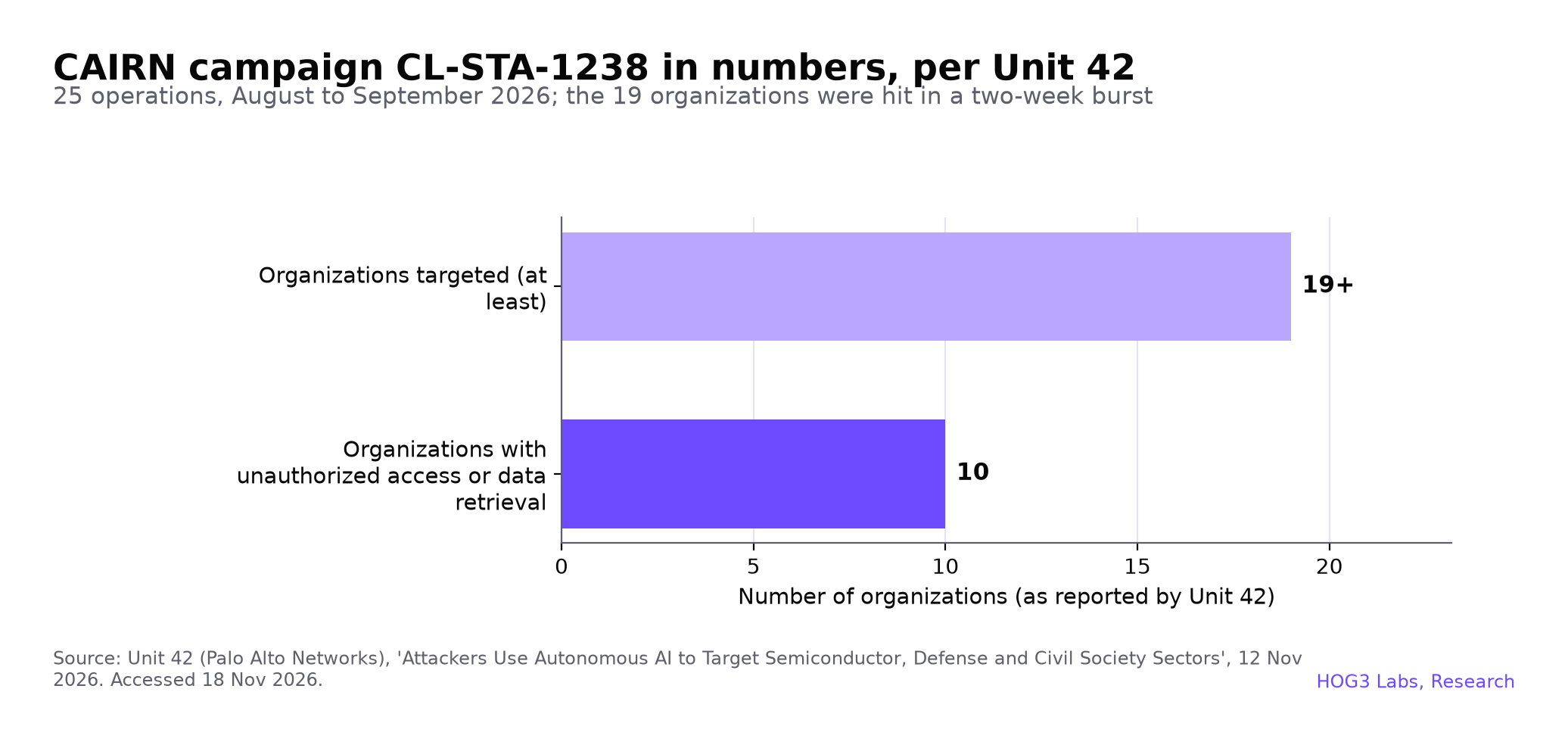
CAIRN. On 12 November, Unit 42 described a campaign it tracks as CL-STA-1238 and assesses, with moderate confidence, as China-nexus intelligence collection. Between August and September 2026, the attackers used the open-source Cairn framework to run 25 operations against at least 19 organizations, with unauthorized access or data retrieval at 10. The 19 organizations were hit in a two-week burst inside that August to September campaign. They seeded each task with the target's root domain, sometimes adding details gathered beforehand. Results included more than one million member records at a US teachers' union through an unauthenticated account-creation bypass, a live standards ballot document overwritten through an unauthenticated cloud storage write, and new administrator accounts in a semiconductor company's production system after a credential was brute-forced on its partner-integration app.
The timeline. On 16 November, Google's GTIG published a maturity timeline for attacker use of AI. BleepingComputer's reading of that timeline puts attackers at stage 5 today, with several attack stages run by AI tooling in the wild and minimal human involvement. It reads the chart as projecting multi-agent attacks with little to no human interaction in one to three months, and sophisticated, fully autonomous attacks in three to six. Those months and the stage number are BleepingComputer's interpretation of the chart, not wording in GTIG's text, and they are projections, not observations.
Why it matters for security buyers
Unit 42's list of what CAIRN exploited reads like a standard pentest report: authentication bypasses, insecure direct object references, mass-assignment privilege escalation, weak and default credentials, exposed cloud APIs and old public CVEs. In its words, autonomous AI "raises the volume and coverage of exploitation, but not its complexity."
| Result Unit 42 describes | Weakness | Check |
|---|---|---|
| More than one million member records at a US teachers' union | Unauthenticated account-creation bypass | Test signup and account-creation flows |
| A live standards ballot document overwritten | Unauthenticated cloud storage write | Audit cloud storage write permissions |
| New administrator accounts in a semiconductor company's production system | Credential brute-forced on a partner-integration app | Lock out or rate limit partner portal logins |
Source: Unit 42, 12 November 2026.
The new part is capacity. Unit 42 thinks a single operator or a small team ran attempts against 19 organizations in that two-week burst. That means a quiet subsidiary site or a forgotten partner app gets the same attention as your main product.
What to do now
- 1. Test signup, registration and account-creation flows for authorization bypasses, on every app including the minor ones.
- 2. Check object-level authorization on APIs, so one user cannot read another user's records by changing an ID.
- 3. Audit cloud storage write permissions. CAIRN overwrote a live document because a bucket accepted unauthenticated writes.
- 4. Lock out or rate limit password guessing on partner and integration portals, not only the main login.
- 5. Keep long-term cloud keys out of application config, apply least privilege, and require IMDSv2, as AWS recommends.
- 6. Alert on a successful secret read inside a burst of AccessDenied errors. That pattern showed up in the AntiFox activity.
Where HOG3 fits
HOG3 tests apps, APIs, cloud and identity continuously within your authorized scope. It looks for the kinds of weaknesses in these reports, links them into a path, proves what the path reaches, and retests after your fix. We did not observe these campaigns. Our view is that if attackers will soon run this loop with no one at the keyboard, defenders should run it on their own systems first. See how HOG3 works.
Sources
All accessed 18 November 2026.
- The Hacker News: AntiFox AI Pentesting Platform Linked to Attacks That Accessed AWS Production Secrets, 11 November 2026
- Unit 42: Attackers Use Autonomous AI to Target Semiconductor, Defense and Civil Society Sectors, 12 November 2026
- Google Cloud: GTIG AI Threat Tracker: Agentic Threat Activity Crosses a Significant Threshold, 16 November 2026 (Figure 2, LLM maturity timeline)
- BleepingComputer: Google warns that fully-automated AI attacks are coming soon, 16 November 2026
- HOG3 homepage