

On 13 November 2026 the FBI published a FLASH alert on ARTEX, an open-source AI pentesting framework that attackers now use to run intrusions. The most useful line for security buyers is not about speed. It is the FBI's list of what ARTEX is good at finding: the peripheral systems that most pentests never scope.
What happened
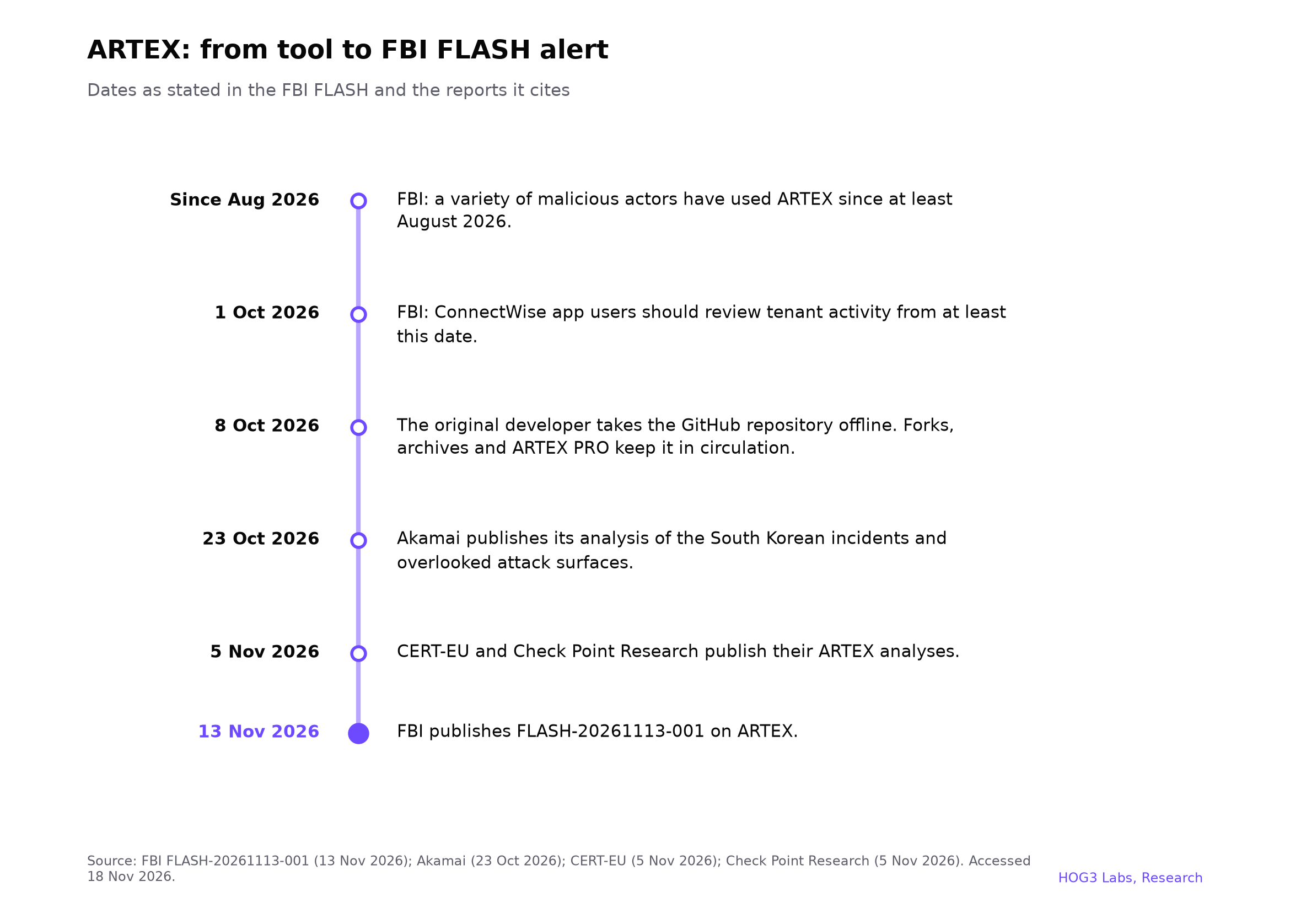
FLASH-20261113-001 describes ARTEX as an open-source, LLM-driven, multi-agent platform written in Go. An operator states a goal in plain language and the agents turn it into commands, with little human input after that. The FBI says a variety of malicious actors have used it since at least August 2026 against financial services, government, technology, defense, semiconductor, energy, healthcare, manufacturing, telecommunications and legal organizations.
Some intrusions went from first targeting to privileged access in under three hours. The FBI names two notable campaigns: attacks on South Korean financial institutions that exfiltrated personal information on about 67,000 people, and a supply chain compromise affecting ConnectWise Cloud Backup customers that led to attempted sign-ins to more than 2,250 downstream tenants.
The original developer took the GitHub repository offline on 8 October 2026. The FBI says forks, archived copies and a commercial version called ARTEX PRO keep it in circulation, and cites Check Point's count of more than 1,600 publicly exposed ARTEX consoles in early November.
The most useful line in the alert
The headline numbers are about speed. The FBI's threat section says something more practical. ARTEX "excels at identifying and exploiting peripheral systems receiving less security attention than flagship applications." The FBI then lists them: partner and supplier portals, mobile backends, employee applications, sales-support systems, legacy services, third-party integrations, and applications built by different business units.
That list comes from Akamai's analysis of the Korean incidents, which the FLASH cites. Akamai says reported targets included a loan inquiry service used by brokers, an employee mobile work-support system and sales-support services. In one case, a service that loan brokers used to check application status exposed personal and credit information on about 25,000 customers. Akamai is careful to add that Korean authorities have not concluded that ARTEX caused every incident in that wave.
Korea's Financial Services Commission reached the same conclusion. According to Akamai, the regulator plans to strengthen assessments of IT assets at external connection points that "may previously have fallen outside normal security evaluation scopes."
| Peripheral system (FBI list) | In our last pentest scope? | Last tested |
|---|---|---|
| Partner and supplier portals | ||
| Mobile backends | ||
| Employee applications | ||
| Sales-support systems | ||
| Legacy services | ||
| Third-party integrations | ||
| Applications built by different business units |
Categories from FBI FLASH-20261113-001, which cites Akamai's analysis. Fill in the blanks for your own estate.
Why it matters for security buyers
A pentest scope is usually drawn around the flagship app and the domains someone remembered to list. An attacker's agent does not read your scope document. It starts from what it can reach and keeps going. CERT-EU makes the same point: ARTEX can test large numbers of low-complexity misconfigurations, "including those a human tester would notice but not have time to check."
So the most useful question for your current provider is simple. Which of our internet-facing systems were not in the last test, and when were they last tested at all?
What to do now
The FBI's recommendations are a good checklist. In short:
- 1. Inventory everything internet-facing, including every category on the FBI's peripheral list. Compare it with the scope of your last pentest.
- 2. Restrict admin paths. Keep cloud administration, Kudu/SCM publishing endpoints, backup platforms and device management on trusted networks or dedicated admin paths.
- 3. Harden partner and employee portals. Enforce server-side authorization on customer records, rate limit, and alert on sequential lookups and unusually high record counts per session.
- 4. Hunt embedded secrets in app config, environment variables, infrastructure as code and CI/CD pipelines, and rotate anything exposed.
- 5. If you used ConnectWise apps, review every Microsoft 365 tenant where they were installed and search by application ID. The FBI says to review activity from at least 1 October 2026.
- 6. Preserve sign-in and audit logs before you change or clean up anything. The FBI gives no date for this one.
- 7. Vet the indicators before blocking. The FBI warns that some IP addresses may have been reassigned and should be checked against current telemetry.
Where HOG3 fits
HOG3 is a continuous AI pentesting platform for apps, APIs, cloud and identity. Within the scope you authorize, it maps what you expose, links weaknesses into a path, proves where that path leads, and repeats the attack after your team ships a fix. We did not observe these campaigns and HOG3 does not detect ARTEX traffic. The lesson we take from the FLASH is narrower: put the peripheral systems in scope, and test them more than once a year. See how HOG3 works.
Sources
All accessed 18 November 2026.
- FBI FLASH-20261113-001: Threat Overview of ARTEX Autonomous Penetration Testing Framework (PDF), 13 November 2026
- BleepingComputer: FBI warns ARTEX AI hacking tool is powering global cyberattacks
- Akamai: What ARTEX Reveals About Overlooked Attack Surfaces, 23 October 2026
- CERT-EU: From Penetration Testing to Cyber Threat: Beware of ARTEX, 5 November 2026
- Check Point Research: Hacking on Autopilot: Inside ARTEX Cybercrime Campaigns, 5 November 2026
- HOG3 homepage