

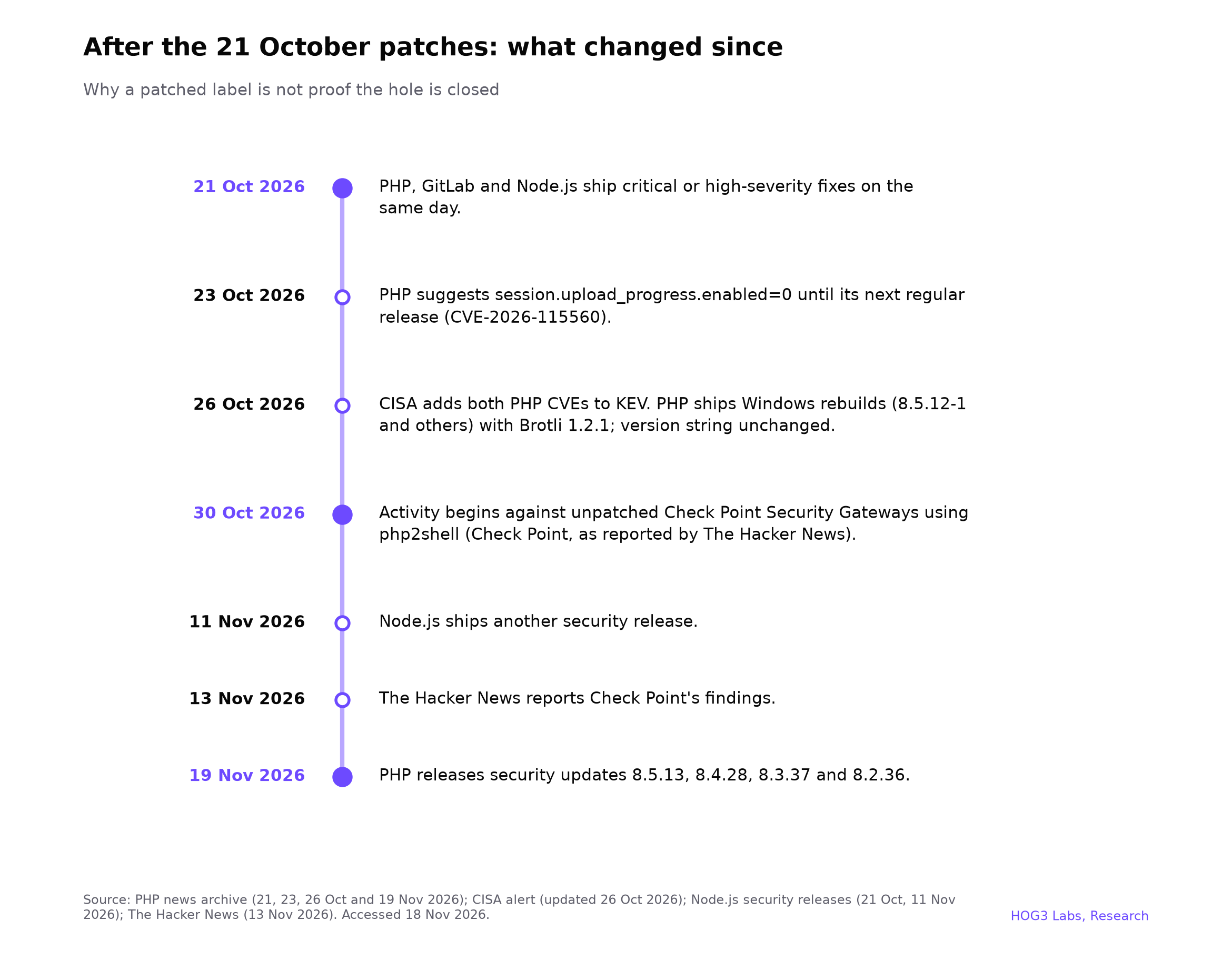
On 21 October 2026, PHP, GitLab and Node.js shipped critical or high-severity fixes on the same day. In the weeks since, attackers have exploited the PHP bugs where the fix had not landed, including on security appliances. Installing an update is the start of the job. The job is finished when you have retested the path and it fails.
What was fixed
PHP (php2shell), CVE-2026-109618 and CVE-2026-109619. Two flaws that can allow unauthenticated remote code execution on any PHP install serving web requests. PHP rates the risk highest for mod_php. Fixed releases are 8.5.12, 8.4.27, 8.3.36 and 8.2.35, and PHP says there are no complete mitigations. CISA added both CVEs to its Known Exploited Vulnerabilities catalog on 26 October.
GitLab, CVE-2026-110264, CVSS 10.0. An integer overflow in the regular expression compiler that, under certain conditions, could let an unauthenticated user run code on a self-managed GitLab server.
Node.js, CVE-2026-111497. A high-severity out-of-bounds write in the bundled Brotli decoder, fixed in 26.12.1, 24.22.1 and 22.23.4. Node says it can lead to a crash, memory disclosure or remote code execution if an app decompresses attacker-supplied Brotli data.
What changed since
Several follow-ups show why "we patched" is not the same as "we are safe."
- PHP inside other products. On 13 November, The Hacker News reported Check Point's findings that attackers used php2shell against unpatched Check Point Security Gateways, with activity beginning 30 October. Check Point says the first activity came roughly a week after a fix was available. The attackers then chained a separate privilege escalation flaw, deployed a backdoor and, in some cases, a wiper. CISA's own alert notes that PHP is often a component of other software, so it is not always easy to see.
- A later PHP setting. On 23 October, PHP suggested setting
session.upload_progress.enabled=0until its next regular release, to fully close an unlikely remote code execution path tracked as CVE-2026-115560. - Same version number, new package. On 26 October, PHP shipped Windows rebuilds (8.5.12-1 and others) that bundle Brotli 1.2.1 for CVE-2026-111497. The PHP version string did not change.
- GitLab's Ruby caveat. The GitLab fix is a patch to Ruby. Self-compiled installs and custom images must also upgrade Ruby to 3.3.13, 3.4.12, 4.0.9 or later. A dashboard showing a fixed GitLab version can still be running vulnerable Ruby.
- More releases. Node.js shipped another security release on 11 November. On 19 November PHP released security updates 8.5.13, 8.4.28, 8.3.37 and 8.2.36, after announcing on 18 November that the highest severity was critical and needed non-default or uncommon setups. Check those release notes against your install.
Google's threat intelligence team adds context. It says the PHP bugs were found with AI-assisted analysis, early patched code circulated before the release, and hundreds of non-working exploits followed. A failed public exploit is not proof that you are safe.
| Component | Fixed in (21 Oct) | Also check |
|---|---|---|
| PHP | 8.5.12, 8.4.27, 8.3.36, 8.2.35 | Windows rebuilds (8.5.12-1 and others) for Brotli; the 19 Nov releases 8.5.13, 8.4.28, 8.3.37, 8.2.36; session.upload_progress setting |
| GitLab (CVE-2026-110264) | Critical patch release, 21 Oct | Self-compiled installs and custom images: Ruby 3.3.13, 3.4.12, 4.0.9 or later |
| Node.js (CVE-2026-111497) | 26.12.1, 24.22.1, 22.23.4 | The 11 November security release |
Sources: PHP news archive; GitLab patch release 19.5.1; Node.js security releases (21 October and 11 November 2026).
Why it matters for security buyers
Your patch report measures change management. It does not measure exposure. The gaps sit in places a version check misses: a vendor appliance, a container base image, a custom Ruby, or a config flag.
What to do now
- 1. Find every place these runtimes live, including appliances, images and platform runtimes. Ask vendors whether their products embed PHP and whether they have shipped the fix.
- 2. Check the artifact, not the label. Record image digests and package revisions, including the PHP Windows
-1rebuild and the Ruby version under custom GitLab installs. - 3. Apply the follow-up guidance, including PHP's
session.upload_progresssetting where it applies and the 11 November Node.js release. - 4. Look back. If a system was internet-facing and unpatched after 21 October, investigate before assuming it is clean. GitLab published two detections for self-managed instances.
- 5. Retest the path under an agreed scope and keep the result. A recorded failed attempt is your evidence that the fix closed the path.
Where HOG3 fits
HOG3 continuously tests apps, APIs, cloud and identity within your authorized scope. After a fix ships, it repeats the relevant attack and checks whether the fix opens another way in. A finding closes only when both checks pass. Some items above, such as appliance firmware or a custom Ruby build, may need your own verification or your vendor's. We will tell you plainly what we tested and what we did not. See how retesting works.
Sources
All accessed 18 November 2026.
- PHP news archive: security advisory (21 October), informational advisory (23 October), Windows builds (26 October), security releases (19 November)
- CISA: Critical Vulnerabilities in PHP Require Immediate Patching, updated 26 October 2026
- GitLab: Critical Patch Release 19.5.1, 21 October 2026
- Node.js: Wednesday, October 21, 2026 Security Releases
- Node.js: Wednesday, November 11, 2026 Security Releases
- The Hacker News: Hackers Exploit PHP2Shell Flaws in Check Point Gateways, 13 November 2026
- Google Cloud: GTIG AI Threat Tracker, 16 November 2026
- HOG3 homepage