

Three incidents disclosed in October at LiteLLM, Railway and PingCAP look different on the surface, but each turned on a working credential in the wrong hands: one left valid by mistake, one trusted beyond its purpose, and one stolen. All three companies have now published detailed reports, and LiteLLM's is the clearest lesson. An admin key was deleted from a public repository within hours but never revoked, and an attacker used it months later.
What happened
LiteLLM. On 21 October, a malicious litellm==1.107.0 was published to PyPI and was live for under two hours, from 11:39 to 13:23 UTC. Compromised Docker image tags were live until 14:20 UTC. LiteLLM says the release contained malware that steals credentials and loads remote code execution tools. The official source tag on GitHub was clean, because the artifacts were built from a lookalike repository.
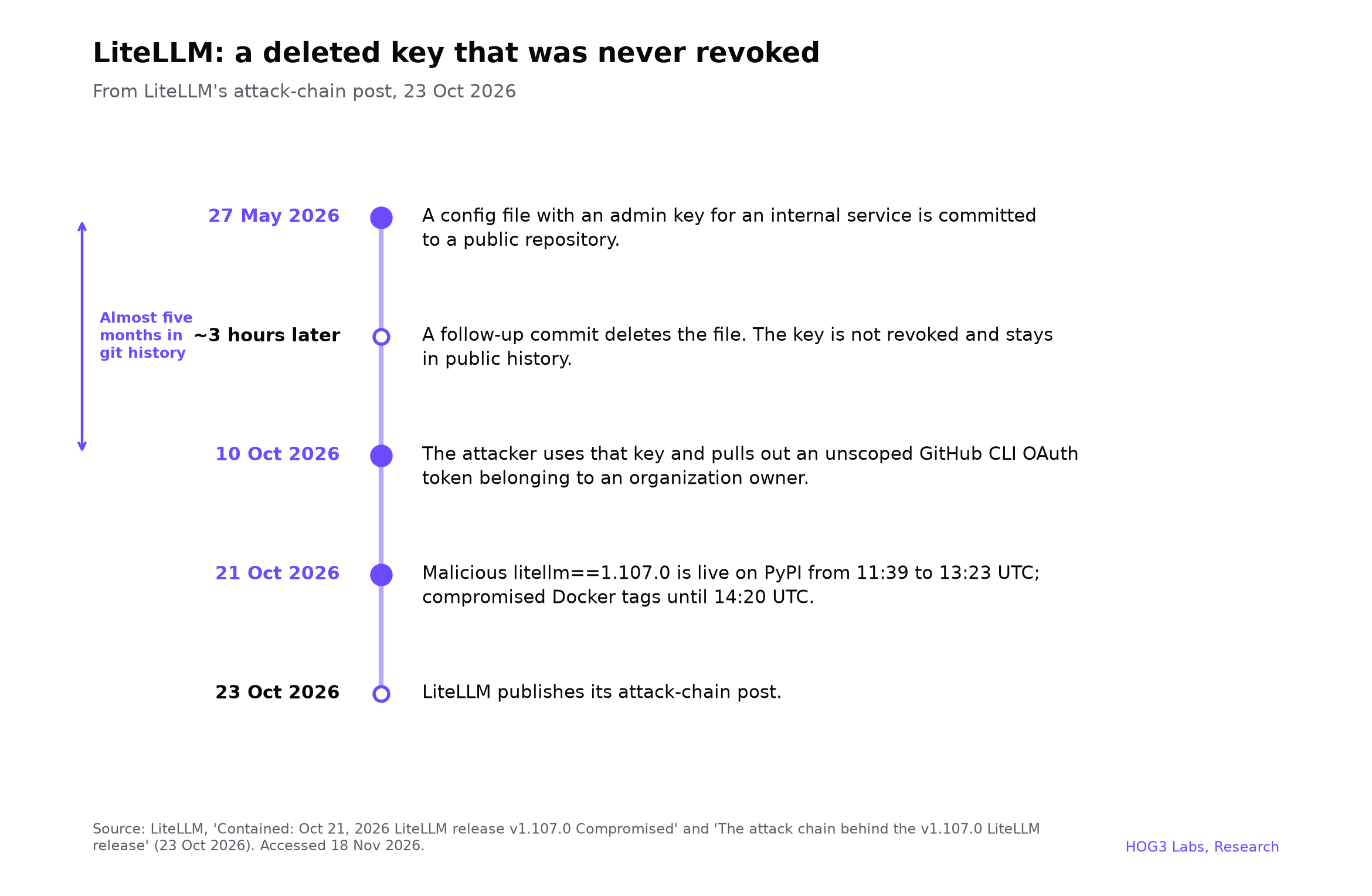
LiteLLM's canonical attack-chain post, published 23 October, explains how. On 27 May, a config file containing an admin key for an internal service was committed to a public repository. A follow-up commit deleted the file about three hours later, but the key was never revoked and the original commit stayed in public history. On 10 October the attacker used that key and pulled out an unscoped GitHub CLI OAuth token belonging to an organization owner. From there the attacker collected more tokens, with a "primary focus on upstream inference API tokens," and on 21 October pushed the poisoned release.
Railway. Railway's incident report, last updated 10 November, says an attacker partly escaped build isolation on 20 October and took a build credential. That credential was meant only for build work, but an internal system accepted it as a trusted client. The attacker later found a misconfigured OIDC binding, reached a machine holding a longer-lived credential on disk, and decrypted environment variables for at most 1.85% of workspaces, about 100,000. Railway believes the attacker was after AI provider credentials. It estimates unauthorized spend on stolen keys at about $740,000 and says refunds vary by provider: AWS and Google Gemini have started refunds, OpenRouter is not refunding, and Railway says it is covering some costs itself, including OpenRouter's.
PingCAP. PingCAP's 19 October report says that between 9 September and 7 October, an unauthorized party used stolen service account credentials to access internal systems, copy data and obtain source code. Exported records included TiDB Cloud account details, billing information and a table of encrypted API key values. An external firm then reported four vulnerabilities, PingCAP fixed them by 14 October, and the firm retested each fix.
Why it matters for security buyers
The common thread is not an exotic exploit. It is credential lifetime and scope. A key that is deleted but not revoked still works. A token with owner rights opens far more than the job it was created for. A long-lived secret sitting on a server is one compromise away from being stolen.
AI keys have also become a target in their own right. Google's threat intelligence team reports attackers stealing LLM and cloud credentials and reselling access to AI models through underground proxy services. Your inference keys deserve the same protection as your payment keys.
| Incident | The credential | What went wrong |
|---|---|---|
| LiteLLM | Admin key for an internal service | Deleted from a public repo but never revoked; used months later |
| Railway | Build credential | Trusted by an internal system beyond its build-only purpose |
| PingCAP | Service account credentials | Stolen and used from 9 September to 7 October 2026 |
Sources: LiteLLM (21 and 23 October 2026), Railway (updated 10 November 2026), PingCAP (19 October 2026).
Notice what PingCAP did after the fixes, too. It did not just close the tickets. An outside firm retested each fix and confirmed it worked.
What to do now
- 1. Revoke, then rotate, then prove it. For any secret that touched a public repo, a log or an affected vendor, revoke it at the issuer and confirm the old value fails.
- 2. Scan git history, not just the latest commit. LiteLLM's key lived in history for almost five months.
- 3. Scope every token to the repositories and actions it needs. Avoid using personal or owner tokens for automation.
- 4. Replace long-lived secrets on servers and in CI with short-lived credentials where you can.
- 5. Treat AI provider keys as tier one secrets. Set spend alerts and watch for usage from outside your infrastructure.
- 6. If you ran LiteLLM 1.107.0, used Railway, or got a PingCAP notice, follow that vendor's published steps. LiteLLM warns against starting with
pipinside an affected environment, because any Python start can rerun the payload.
Where HOG3 fits
Exposed credentials and leaked source or secrets are among the finding types HOG3 shows on its homepage. Within your authorized scope, HOG3 tests apps, APIs, cloud and identity, shows where a leaked credential leads, and repeats the attack after your team rotates or fixes it. That way "rotated" means the old path no longer works. We had no involvement in these incidents. See how HOG3 works.
Sources
All accessed 18 November 2026.
- LiteLLM: Contained: Oct 21, 2026 LiteLLM release v1.107.0 Compromised
- LiteLLM: The attack chain behind the v1.107.0 LiteLLM release, 23 October 2026
- Railway: Incident Report: October 21st Security Attack, updated 10 November 2026
- PingCAP: Security Incident Report: Unauthorized Access to PingCAP, 19 October 2026
- Google Cloud: GTIG AI Threat Tracker, 16 November 2026 (LLMJacking section)
- HOG3 homepage