

Picture a Roller admin who did everything the settings page asked. Months ago they opened Server Settings and turned XML-RPC off, because nobody on the team posts from a desktop blog client anymore. The checkbox saved. The blog kept running.
The URL /roller-services/xmlrpc kept running too. In every Roller release before 6.1.6, that servlet is mapped no matter what the checkbox says, and the XML-RPC library behind it is configured with vendor extensions turned on. One of those extensions, ex:serializable, takes base64 bytes from the request body and hands them straight to Java's ObjectInputStream.readObject(). That happens while the XML is being parsed, before Roller looks up a handler and long before it asks who is calling.
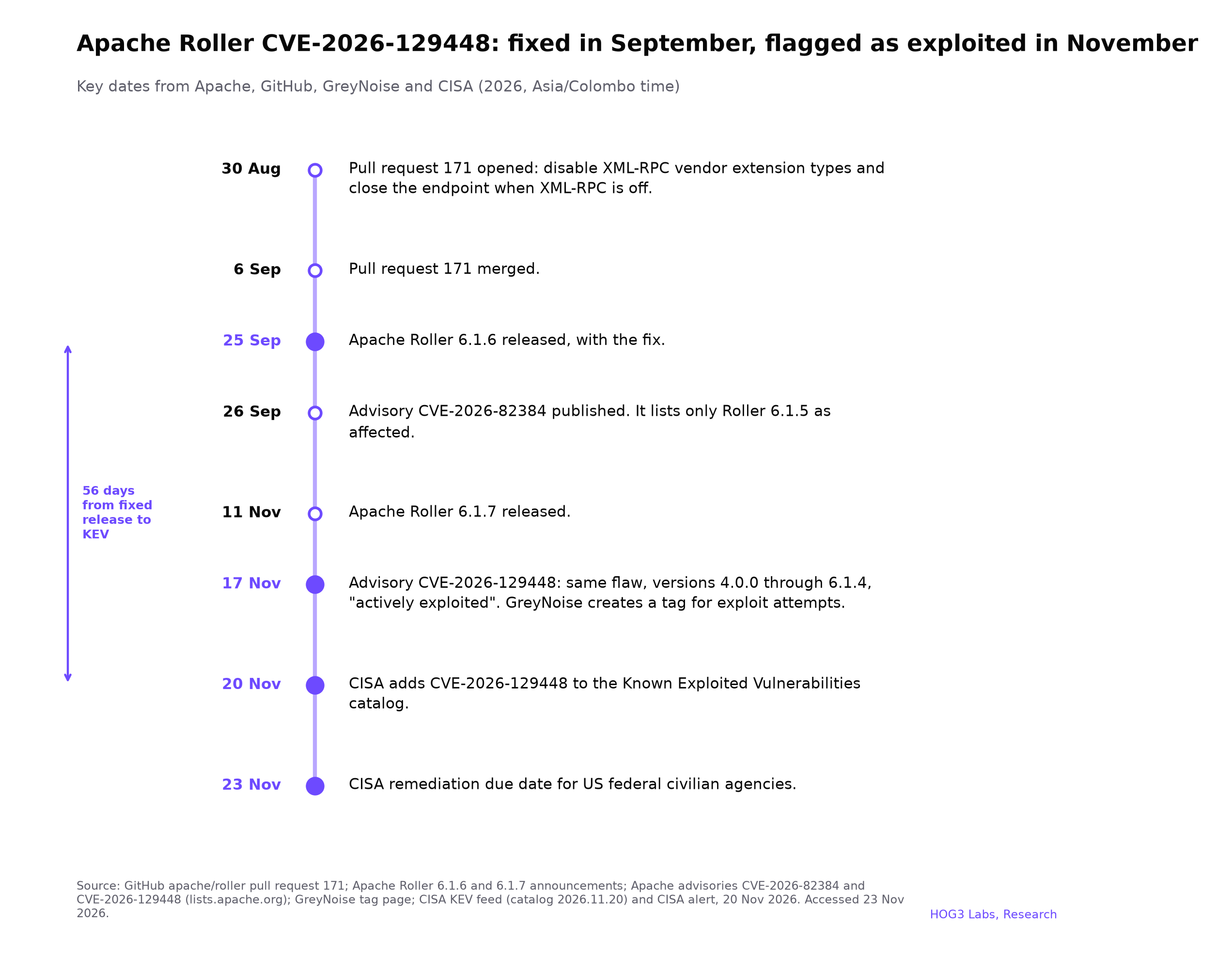
Apache calls that CVE-2026-129448, scores it 9.8, and says it is being actively exploited. CISA added it to its Known Exploited Vulnerabilities (KEV) catalog on 20 November 2026 with a remediation due date of today, 23 November 2026.
TL;DR
- What: unauthenticated deserialization of untrusted data in Apache Roller's XML-RPC endpoint, which Apache says allows an unauthenticated remote attacker to execute arbitrary code.
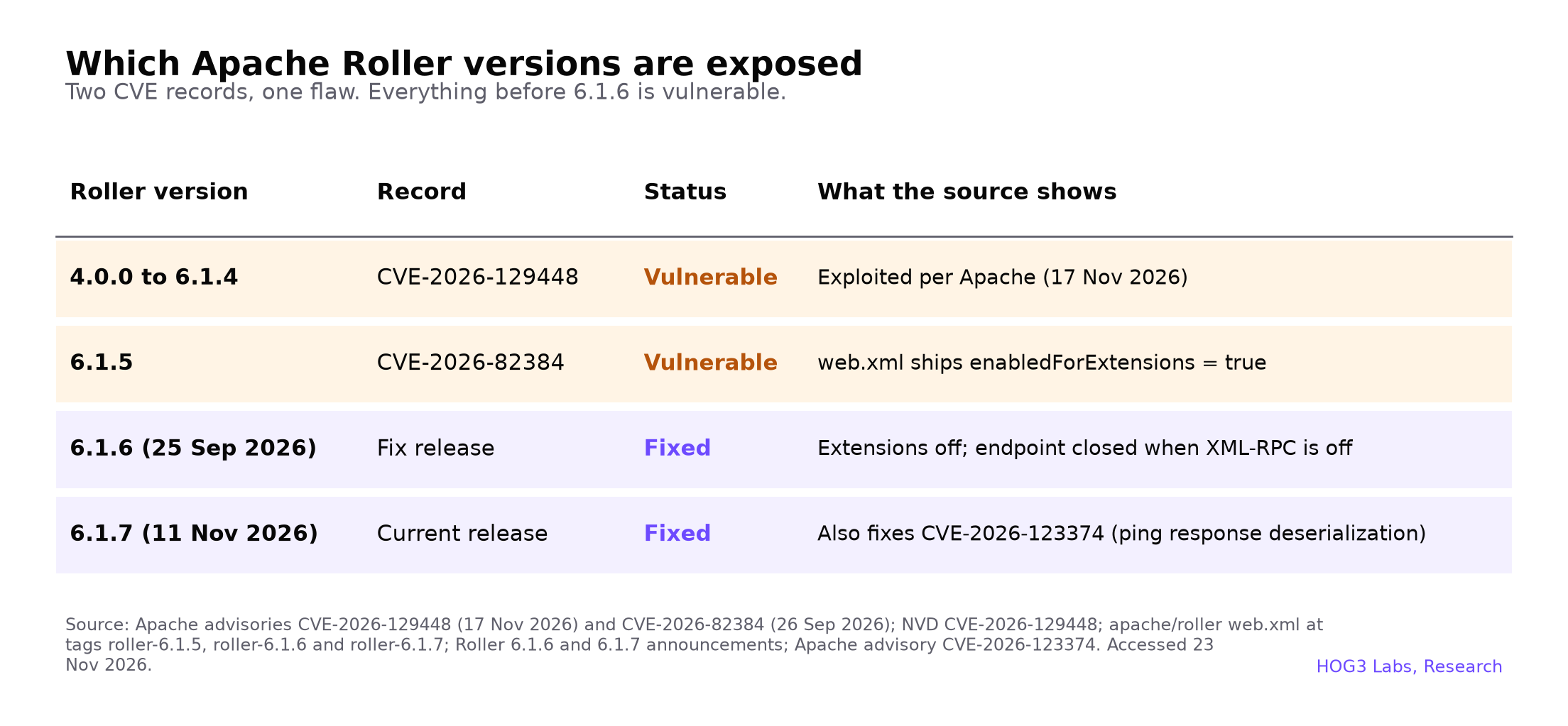
- Affected: Roller 4.0.0 through 6.1.4 (CVE-2026-129448) and Roller 6.1.5 (CVE-2026-82384, the same flaw under its first CVE). In plain terms: everything before 6.1.6.
- Fixed in: Roller 6.1.6 (released 25 September 2026) and later. The current release is 6.1.7 (11 November 2026).
- Severity: CVSS 3.1 base score 9.8, Critical, vector
AV:N/AC:L/PR:N/UI:N/S:U/C:H/I:H/A:H. - Exploited? Yes, per Apache's 17 November advisory. CISA KEV added 20 November 2026, due 23 November 2026, known ransomware use: unknown.
- The trap: turning XML-RPC off in the admin UI does not protect older versions. Apache says so directly.
- If you can't upgrade today: set
enabledForExtensionstofalseinWEB-INF/web.xml, or remove the/roller-services/xmlrpcservlet mapping, then restart Roller.
The facts, from the record
| Item | What the source says | Source |
|---|---|---|
| Advisory | CVE-2026-129448, published 17 November 2026, severity Critical | Apache Roller advisory |
| Flaw | Deserialization of untrusted data (CWE-502) in the XML-RPC endpoint, before authentication | Apache, NVD |
| Score | CVSS 3.1 9.8, AV:N/AC:L/PR:N/UI:N/S:U/C:H/I:H/A:H | Apache (via NVD) |
| Affected | 4.0.0 through 6.1.4 | Apache, NVD |
| Same flaw, first CVE | CVE-2026-82384, published 26 September 2026, listed only 6.1.5 | Apache, NVD |
| Fixed | 6.1.6 or later | Apache |
| Exploitation | "This issue is being actively exploited." Apache gives no detail on who or how | Apache; BleepingComputer; The Hacker News |
| CISA KEV | Added 20 November 2026; due 23 November 2026; known ransomware campaign use: unknown; flagged for CISA's forensics triage requirements | CISA KEV feed |
| CISA SSVC | Exploitation: active; automatable: yes; technical impact: total | NVD (CISA ADP) |
| EPSS | 0.05459 (about 5.5 percent), 92.9th percentile, scored 22 November 2026 | FIRST EPSS API |
| Exploit attempts seen | GreyNoise created a tag for IPs attempting to exploit it on 17 November 2026 | GreyNoise |
| Credit | n0mi1k (finder), Matt Raible (reporter) | Apache |
Why two CVEs for one bug
In September, Apache published CVE-2026-82384 and named only Roller 6.1.5 as affected. If you ran 6.1.4 or older, that advisory read like it did not apply to you.
On 17 November, Apache published CVE-2026-129448 to correct that. Its words: "This is the same vulnerability as CVE-2026-82384, which listed only Apache Roller 6.1.5 as affected. This issue is being actively exploited." The fix did not change. It was in 6.1.6 all along.
So the people most exposed are the ones running older Roller who read the first advisory carefully and concluded they were fine.
How it works, without the exploit
We checked the source, not just the advisories.
- Roller 6.1.5's web.xml configures the XML-RPC servlet with
enabledForExtensionsset totrue, and maps it to/roller-services/xmlrpcwith no condition attached. - Roller bundles Apache XML-RPC 3.1.3. In that library, when extensions are enabled, a value tagged
ex:serializableis handled bySerializableParser, which base64-decodes the bytes and callsObjectInputStream.readObject()on them. - Parsing comes first. Authentication and the admin UI's XML-RPC toggle are checked later, by Roller's handlers. By then the object has already been deserialized.
Roller 6.1.6 changed two things in web.xml, both visible in the release source: enabledForExtensions is now false, and a new XmlRpcEnabledFilter sits in front of /roller-services/xmlrpc so the endpoint closes when XML-RPC is switched off. The pull request that made the change, apache/roller#171, describes it the same way: Roller "uses only the standard XML-RPC value types", so the extensions can go.
Whether a given deserialization turns into code execution depends on what classes are on the server's classpath and the Java runtime in use. Apache rates the result as remote code execution, and so should you. We are not publishing payloads or gadget details.
Affected and fixed versions
| You run | Status | Move to | Notes |
|---|---|---|---|
| Roller 4.0.0 to 6.1.4 | Vulnerable (CVE-2026-129448) | 6.1.7 | Exploited per Apache. Read the 6.1.6 and 6.1.7 behaviour changes before upgrading a live site |
| Roller 6.1.5 | Vulnerable (CVE-2026-82384) | 6.1.7 | Same flaw, first advisory |
| Roller 6.1.6 | Fixed for this CVE | 6.1.7 | 6.1.7 fixes CVE-2026-123374, a separate deserialization flaw in weblog update ping responses (affects 4.0 through 6.1.6) |
| Roller 6.1.7 | Fixed | Stay current | The Roller site lists 6.1.7 as the "best available" release |
Source: Apache advisories CVE-2026-129448, CVE-2026-82384 and CVE-2026-123374; Roller 6.1.6 and 6.1.7 announcements; roller.apache.org downloads.
Two upgrade notes from Apache's 6.1.6 announcement worth knowing before you start: new installations now need a one time setup token that Roller prints to the server log, and an installation still set to WSSE AtomPub authentication fails on startup, so change authentication.method to basic or oauth first.
What to do now
1. Find every Roller instance. Include old team blogs, staging copies and anything on a forgotten subdomain. Record the version actually deployed, not the one in the wiki.
2. Upgrade to 6.1.7. 6.1.6 fixes this CVE. 6.1.7 also closes CVE-2026-123374. Apache recommends 6.1.6 or later.
3. If you can't upgrade today, apply Apache's interim fix. Either set enabledForExtensions to false in WEB-INF/web.xml, or remove the /roller-services/xmlrpc servlet mapping. Then restart Roller. Do not rely on the XML-RPC checkbox in Server Settings: Apache says "Disabling XML-RPC in the administration UI is not enough, because older versions deserialize the request before checking that setting."
4. Treat an exposed, unpatched server as possibly compromised. Apache says the flaw is exploited and CISA flags it for forensics triage. Patching closes the door. It does not tell you whether someone already walked through it. Review web server and application logs for POST requests to /roller-services/xmlrpc, especially if your team never used an XML-RPC blog client. Look for unexpected processes, files or outbound connections from the Java process running Roller. GreyNoise publishes the IPs it has tagged for exploit attempts.
5. Verify the fix where it runs. Confirm the deployed WEB-INF/web.xml has enabledForExtensions set to false and, on 6.1.6 or later, the XmlRpcEnabledFilter mapped to /roller-services/xmlrpc. If you do not use XML-RPC, confirm from outside your network that requests to the endpoint are rejected, not just that the admin UI says it is off. Check every node behind the load balancer, not only the one you patched first.
What this says about switches and endpoints
The settings page said XML-RPC was off. The server still accepted and parsed XML-RPC. That gap between what a configuration screen shows and what an endpoint actually answers is common, and it does not show up in a version inventory or a settings review. It shows up when someone sends requests to the endpoint from the outside, without credentials, and looks at what comes back.
The second lesson is about advisories. The fix shipped on 25 September. The first advisory named one version. From the first advisory on 26 September until the corrected one on 17 November, 52 days, a careful reader on 6.1.4 or older had reason to think they were not affected. Testing what your servers actually do, rather than matching version strings to advisory text, is what closes that kind of gap before a KEV deadline does it for you.
Where HOG3 fits
HOG3 continuously tests apps, APIs, cloud and identity within an authorized scope, with proof of impact, and retests after a fix. For a flaw like this one, the useful questions are which of your hosts answer on an unauthenticated endpoint they should not, whether a disabled feature is really closed, and whether the fix holds on every node after you deploy it. We will be plain about what we tested and what we did not. See how HOG3 works.
FAQ
What is CVE-2026-129448? An unauthenticated deserialization flaw in Apache Roller's XML-RPC endpoint, rated CVSS 3.1 9.8. Apache says it allows remote code execution and is being actively exploited.
Which Roller versions are affected? Roller 4.0.0 through 6.1.4 under CVE-2026-129448, and Roller 6.1.5 under CVE-2026-82384, which is the same flaw. Every version before 6.1.6 is vulnerable.
Which version fixes it? Roller 6.1.6 and later. The current release is 6.1.7, which also fixes a separate deserialization flaw, CVE-2026-123374.
I turned off XML-RPC in Server Settings. Am I safe? No. On versions before 6.1.6 the servlet stays mapped and deserializes the request before checking that setting. Use the web.xml change or remove the servlet mapping, or better, upgrade.
Is there a workaround? Apache's interim steps are to set enabledForExtensions to false in WEB-INF/web.xml, or remove the /roller-services/xmlrpc servlet mapping, then restart Roller. Upgrading is the real fix.
Is it in the CISA KEV catalog? Yes. CISA added CVE-2026-129448 on 20 November 2026 with a remediation due date of 23 November 2026. Known ransomware campaign use is marked unknown.
How is CVE-2026-129448 different from CVE-2026-82384? It is the same vulnerability. CVE-2026-82384, published in September, listed only 6.1.5. CVE-2026-129448 covers 4.0.0 through 6.1.4 and adds that the issue is actively exploited.
Do I need to check for compromise after patching? If the server was reachable and unpatched, yes. Patching stops new exploitation. It does not remove anything an attacker left behind.
Sources
All accessed 23 November 2026.
- Apache Roller advisory: CVE-2026-129448 (lists.apache.org)
- Apache Roller advisory: CVE-2026-82384 (announce@apache.org)
- NVD: CVE-2026-129448
- NVD: CVE-2026-82384
- GitHub: apache/roller pull request 171, Disable vendor extension types on the XML-RPC servlet
- Apache Roller advisory: CVE-2026-123374
- Apache Roller 6.1.6 release notes
- Apache Roller 6.1.7 release notes
- Apache Roller downloads
- CISA: Known Exploited Vulnerabilities Catalog
- CISA: CISA Adds Four Known Exploited Vulnerabilities to Catalog, 20 November 2026
- FIRST: EPSS score for CVE-2026-129448
- GreyNoise: Apache Roller XML-RPC Deserialization CVE-2026-129448 RCE Attempt
- BleepingComputer: Apache warns of Roller RCE vulnerability exploited in attacks
- The Hacker News: Critical Apache Roller RCE Flaw Under Active Exploitation
- SecurityWeek: Critical Apache Roller, Axis Vulnerabilities Exploited in Attacks
- HOG3 homepage